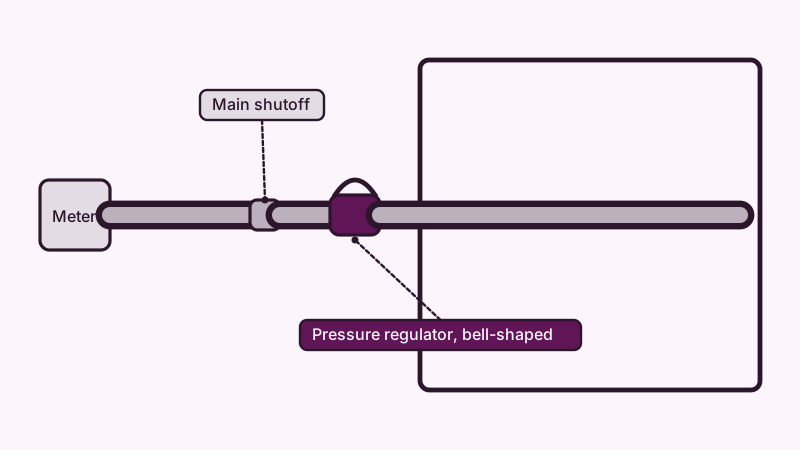
Begin at the point where water enters the property. The regulator, sometimes called a pressure-reducing valve, normally interrupts the main pipe a little past the shut-off valve or meter connection. Look in the garage, along an exterior wall, inside a service closet, or in a box sunk into the ground out front. Plenty of homes have none. For other pressure complaints, our help with low water pressure covers causes beyond the regulator.
Where in the house should I look for it?
Trace the supply pipe back from the meter, or from the spot where it passes through the foundation. The first device after the main shut-off is typically the regulator: a bronze, bell-shaped fitting topped with an adjusting screw. Common homes for it are the garage, an outside wall, near a front hose bib, or a service closet.
A few places repay a check. Where the main comes in on the street side, scan around the hose bib, any wall box and any ground-level cabinet. Where it comes in through the garage, follow the wall behind the water heater to the first shut-off. Hillside homes and older beach cottages may route things differently, perhaps with the regulator reached through a crawl space hatch, and a plumber can trace it. Wikipedia describes a regulator as a valve holding pressure at a set value, which is why it has to sit on the main, ahead of every branch.
How can I recognize a regulator on sight?
Most residential units are a bell or dome in brass or bronze, roughly grapefruit-sized, with a threaded adjusting screw and lock nut on top. An arrow on the body marks flow direction, and unions sit on one or both sides. A small strainer housing may be next to it.
A gauge port or fitted pressure gauge may sit beside it, and the maker's name is usually cast into the body. A brass bell with an adjusting screw on its crown is the regulator. If the pipe by the main shut-off is only straight pipe and a handle, there may be none, or it may live in a wall access or an underground box. Cannot find it? Ask a plumber to say whether the house has one and whether it should.
Is a regulator standard in every house?
No. One is needed where street pressure runs high. The plumbing code in this state wants a regulator whenever resting pressure in the supply piping tops 80 psi, and the device must bring it to 80 or below. Where utility pressure already falls within range, a house may well go without.
The code adds that each regulator must be reachable, above ground or in a drained vault, protected from freezing, with a strainer ahead of it that can be cleaned without removing the regulator. An expansion tank is often needed in the cold supply downstream of a regulator, so thermal expansion cannot push pressure past 80 psi, and a plumber can tell you whether yours does. Look for the tank near your water heater. A house with no regulator and pressure under 80 psi breaks no rule.
How can I test a regulator's condition?
Attach a gauge to an outside spigot or laundry tap, shut every fixture and note the resting pressure. Bob Vila gives a normal span of 40 to 80 psi; below it, or a needle that wanders while water runs, points at a failing regulator. Rheem prefers 40 to 60 psi because it is gentler on the heater.
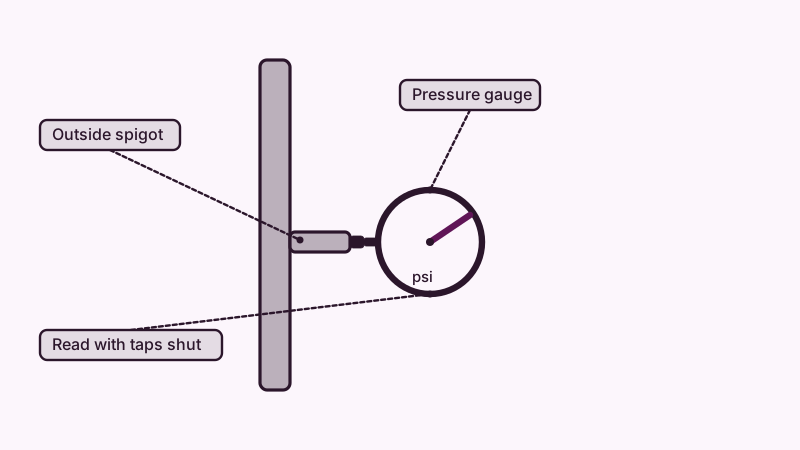
Gauges are cheap at hardware stores. Read it with nothing running, then open a tap and see whether the needle dives or flutters. Warning signs for a tired regulator: steady low pressure, sudden swings, banging pipes or pressure creeping up overnight. A leak or a half-shut main valve can mimic these, so diagnosis by a plumber matters. For other explanations, read reasons water pressure drops.
Is it safe to adjust one myself?
Some regulators have an adjusting screw and lock nut, and small turns shift pressure, but a slip can leave you with dangerously high or barely any pressure. The maker's instructions rule, and a plumber with a gauge should make the changes. Leave alone one that is leaking, noisy or old.
If you do adjust, slacken the lock nut, give the screw a slight turn, read the gauge with water off and lock the nut again. Clockwise generally raises pressure. Go in small steps and trust the gauge, not the feel of a tap. A regulator that cannot hold its setting, or drifts, wants replacing rather than tuning. Steps and cautions are in our guide to adjusting a pressure regulator.
At what point does a regulator need replacing?
Replace one that leaks, cannot hold pressure, makes noise, or lets pressure creep above 80 psi. Regulators wear, and there is no single fixed lifespan that applies to every make. A plumber can test and quote a replacement and check the expansion tank at the same time.
The plumber closes the main, drains the line, cuts in a new valve or swaps the body at its unions, and tests under pressure. This touches the main supply, so call in someone who carries a California contractor license, and a permit may be involved; Building and Safety at (310) 618-5910 can say, or the plumber will check. Further reading: regulator replacement and installation cost.
Why does regulator health affect leaks and hammer?
Too much pressure punishes pipes, fixtures and appliances alike, and often explains leaks, noisy lines and early tank or hose failures. A healthy regulator keeps pressure below the limit set by code and protects the whole system. Thumping pipes are one symptom of poor control.
If you have had repeated leaks, check pressure before you replace anything else. Two related guides, what makes a pipe burst and water hammer noise, explain how pressure spikes do damage. If your shower seems weak instead, low shower pressure lists tests for that.
Where does this leave me?
Found the regulator and your gauge reads outside the 40 to 80 psi band? Have a plumber test it. Could not find one? Ask the plumber to trace the main. A visit starts with the quote form, while our home page covers everything else we offer.
Common questions
Where is the regulator normally installed?
Typically on the incoming pipe immediately past the shut-off valve, close to the point of entry: a garage, exterior wall, service closet or ground-level box are all common. Look for a bronze bell with an adjusting screw at the top.
How do I tell a regulator has gone bad?
Pressure that is very low, very high, swinging with flow or creeping up at night, plus banging pipes and leaks. Fit a gauge to an outdoor spigot and it gives the figure. Bob Vila says a reading outside about 40 to 80 psi, or a swinging one, means a plumber should adjust or replace the valve.
Does California require one?
The state code requires a regulator if resting water pressure in the supply exceeds 80 psi, and an expansion tank is often needed downstream. Where street pressure already falls within range you may not have one. Local rules apply too, and a plumber can confirm what fits your house.
Can a homeowner swap a regulator?
Because it touches the main supply, leave it to a contractor holding the state license; one slip can flood the house or leave pressure unsafe. Verify any contractor on cslb.ca.gov before agreeing to the work, and ask who files any permit.
What pressure should a house run at?
Bob Vila gives a typical band of 40 to 80 psi, while the code asks for a regulator beyond 80. Rheem prefers 40 to 60 psi to ease the load on water heater tanks and connections. A gauge reading shows where your house sits.
Sources used
- Wikipedia, Pressure regulator
- California Plumbing Code 2025, section 608.2 Excessive Water Pressure (summary of requirements and access)
- Bob Vila, low water pressure causes and fixes (pressure-reducing valve symptoms and gauge test)
- Rheem, water heater maintenance (40 to 60 psi)
- California Contractors State License Board, hire a contractor
Last updated