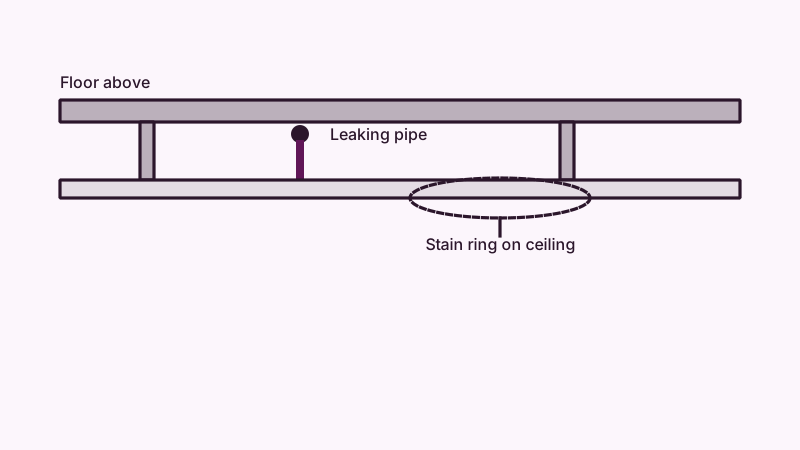
A ceiling that has taken on water tells you three things by how it looks: how much water there was, how long it has been arriving, and whether the board can be saved. Brown rings with crisp edges usually mean repeated wetting; a bulge means a pocket of trapped water; a sag means the drywall has lost its strength. Compare your ceiling with the descriptions below, and visit our leak plumber hub if the source is still a mystery.
What do the different kinds of ceiling damage mean?
A pale yellow or brown stain with a ring is old or intermittent moisture. A bulging, wet patch holds water right now. Sagging or cracked drywall has soaked through and may fall. Peeling paint and blistering point to moisture from above or from humid air. Dark specks suggest mold has started. Each calls for a different urgency, and the bulge and the sag are the urgent ones.
Reading it:
- Stain only, dry to the touch. Mark the edge in pencil with the date. If the ring grows, the leak is live.
- Bulge. Water is trapped behind the paint. The usual advice is to place a bucket beneath and relieve it by piercing the lowest point with a screwdriver, standing to the side, since the water can come out suddenly and may be dirty.
- Sag or crack. The board has lost strength. Keep people out of the room.
- Peeling, bubbling or fuzzy patches. Moisture has been present for a while; look for mold.
If light fixtures, fans or smoke detectors sit in the wet area, switch off that circuit. Water and wiring in a ceiling is a shock and fire risk, not only a stain.
Where is this water originating?
Inspect whatever sits directly overhead and a little uphill of the stain. Usual suspects: a bathroom or laundry upstairs, a supply or drain pipe running through the attic or ceiling cavity, a roof leak creeping along a rafter, or an air-conditioner condensate line. Water travels along framing, so the source can be several feet from the damage.
A quick elimination:
- Does it show up only in rain? Think roof, flashing or a vent boot.
- Does it show up after showers or laundry? Think drain lines, a shower pan, a tub overflow or a toilet's wax ring overhead.
- Does it drip constantly? Think a pressurized supply line, and run the meter test described on the water bill page.
- Is another unit overhead? In a condo, townhome or apartment, put the owner or manager on notice by email or letter; the source lies outside your walls.
In Torrance's older two-story tract homes, a bathroom directly over a hallway or living room is a classic setup, with a worn shower valve or a perished tub-drain gasket as the culprit. A burst or pinhole supply line in the attic is a faster and bigger event; see the burst water pipe guide.
What should I do first, before any repair?
If you can find where the water originates, stop it there with a fixture shutoff; if not, turn off the main. Then protect people, contents and the ceiling itself. Move furniture away, catch drips, photograph everything for your insurer, and start drying the area. Painting over a wet stain seals the moisture in and invites mold, so hold the brush.
Photograph the damage in good light with a coin or tape measure for scale, and take a short video of any active dripping. Keep any failed part. Insurers often distinguish sudden from gradual damage, and how that plays out is in insurance and burst pipes.
What should be cut out, and what can be dried and kept?
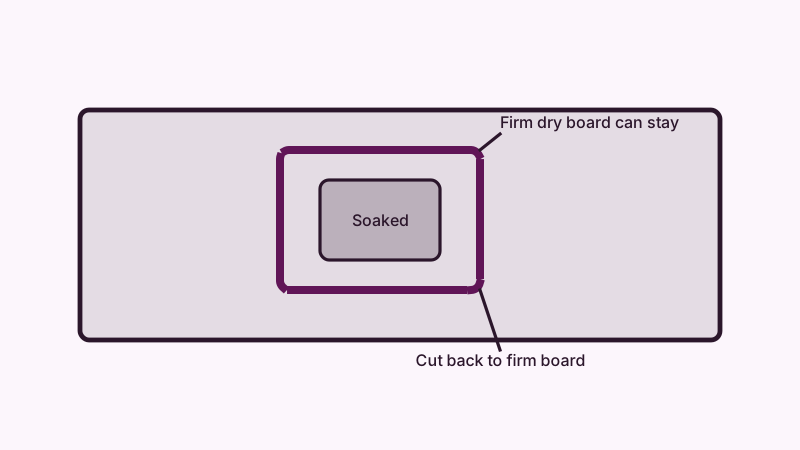
Drywall that has sagged, crumbled or remained soaked past the second day usually has to come out, wet insulation with it. A stain on firm, dry board can be sealed and repainted after the source is repaired. EPA says absorbent items like ceiling tiles may need discarding if mold sets in.
Rules of thumb that follow EPA's mold guidance:
- Fix the leak first. Repairing a ceiling under an active leak is wasted money.
- Dry everything completely with fans and a dehumidifier before closing anything up.
- A moldy area under about 10 square feet can often be handled by the homeowner using proper protection. Beyond that, or after a lot of water damage, consider a professional.
- Contaminated water, such as sewage, calls for a professional.
One caution for older homes: textured or "popcorn" ceilings in houses built before the early 1980s may contain asbestos, and you cannot tell by looking. Contractor and lab guides advise testing a sample before cutting, scraping or sanding, and disturbing positive material is regulated work. Ask the regional air district and Cal/OSHA what applies, and avoid breaking the material up in the meantime. EPA also warns that vermiculite attic insulation should be presumed to contain asbestos and left undisturbed.
How is a water-damaged ceiling repaired?
Once the leak is stopped and everything has dried, the finisher cuts the drywall back to sound board, screws new board to the framing, tapes the seams, then primes with a stain blocker and paints. A texture match is the final touch. Expect two trades: a plumber for the source, then a drywall and paint specialist.
Order matters: the plumbing should be finished, and inspected if a permit applies, before the ceiling is closed. When the plumber must open the ceiling to reach a pipe, ask for an opening shaped so the later patch is simple. A stain-blocking primer matters because water stains bleed through ordinary paint.
A stain without an active leak is the subject of water spots on a ceiling with no leak, and a ceiling that is dripping this minute is dealt with under ceiling water leak.
Common questions
Is a sagging ceiling an emergency?
Yes. Wet drywall is heavy, and a sagging section can drop without warning. Keep everyone out from underneath, move belongings, switch off power to the area if fixtures are in the wet zone, and stop the water at its source. A professional should open it in a controlled way.
Can I just paint over a ceiling stain?
Only after the leak is fixed and the area is completely dry, and then use a stain-blocking primer first. Ordinary paint over a damp stain hides the problem, traps moisture and often lets the stain bleed back through within weeks.
How soon can mold appear?
Mold can start growing on wet material, and EPA says to dry everything completely and fix leaks as soon as possible. The longer drywall and insulation stay damp, the more likely mold becomes. Open the area, dry it and look for fuzzy or dark growth.
Who repairs it, a plumber or a handyman?
Both, in sequence. The plumber's job is the leak, and a drywall and paint finisher handles the ceiling. Contractor licensing in California starts at a $1,000 job, so verify each contractor's number with CSLB. To begin, use our quote page.
Does the ceiling need to be opened to find the leak?
Often not at first. Moisture meters, thermal cameras and pressure tests let a plumber narrow the source and cut only a small access hole. When the stain sits under a bathroom, the answer is usually in the room above, so start there before touching the drywall.
The rest of our guides start from plumber across Torrance.
Sources used
- EPA, Mold Cleanup in Your Home
- EPA, Protect Your Family from Asbestos-Contaminated Vermiculite Insulation
- Contractor and testing-lab guides on asbestos in textured ceilings, checked November 2026
Last updated