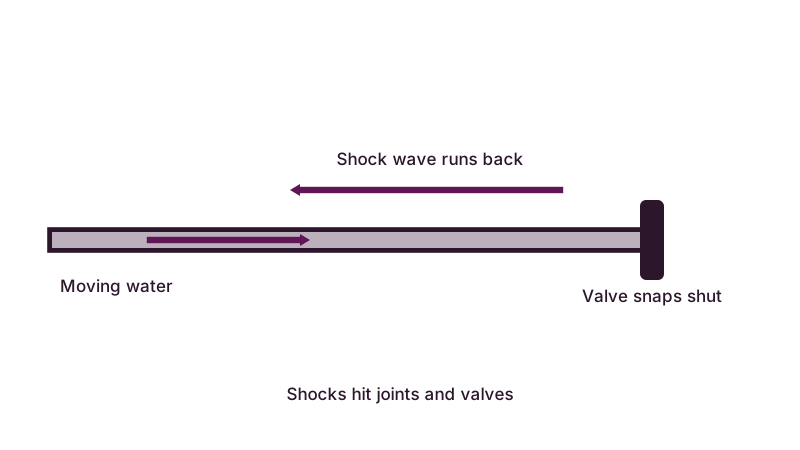
Close a tap and something thumps inside the wall. That thump is water hammer: a moving column of water stopped dead, with the shock traveling back through the pipe. It is common, usually curable, and worth curing, since every jolt works on joints and valves. Del Amo Plumbing can line up a local plumber when the checks below fall short.
What is happening inside the pipe when it bangs?
A pressure surge. Water in motion meets a valve that snaps shut, and the shock runs back along the pipe as a bang, knock or shudder. Fast valves are the usual trigger: a washer solenoid, a dishwasher valve, a one-lever faucet, acting on pipes that are loose or have lost their cushion.
Listen to the pattern. One sharp bang as the tap closes is the textbook case. A rattle like a machine gun while water runs suggests a loose washer, a worn valve or a pipe free to wander. A steady hum or squeal is a separate matter, often a partly closed valve or high pressure squeezing through a narrow gap.
Notice which fixture sets it off. A thud each time the washing machine fills implicates its inlet valve. A bang from the whole house, whichever tap you use, implicates pressure or a system with no cushioning left.
What makes pipes knock after a tap is closed?
Three culprits account for most knocking: pipes that are unstrapped and slap the framing, high pressure that magnifies every surge, and a cushion that has failed, either an air chamber full of water or a worn arrestor. Each calls for its own remedy, so identify yours before you buy anything.
Many postwar houses in Torrance, Gardena and Lawndale have long straight runs of copper or galvanized pipe through crawl spaces, and pipe straps loosen over the decades. Beach-city cottages with remodeled kitchens often join old pipe to new fixtures, and a fast-closing modern faucet on tired plumbing is a frequent source of the bang.
Heating systems can knock as well, but that is typically a hydronic loop and not the cold-side surge covered here. Gas lines tick or hum for other reasons, and the smell of gas is never part of water hammer. Gas has an odor of its own. If you notice it, go outdoors and phone the utility, SoCalGas, at 1-800-427-2200.
How can I stop water hammer myself?
Begin with the free checks. Secure any pipe you can see and reach, close taps gently, then turn off the house supply, open the top and bottom faucets to empty the lines, and turn it back on. That can recharge old air chambers. A knock that returns within days means the cushion is spent, and a part is the next step.
On exposed pipe, foam insulation and a padded hanger every few feet damp the movement. Do not drive a nail through a strap or clamp a pipe so tight it cannot expand. Anything inside a wall is plumber territory.
Look at the washing machine too. Its hoses should sit snug, and its inlet valves are a prime suspect. A bang each time the cold fill cuts out is a strong clue. A small arrestor screws on between the faucet and the hose, and some owners fit one there.
Do I need one of those little arrestor devices?
An arrestor is a sealed cylinder holding a piston or bladder that soaks up the shock, mounted near a fast-closing valve. The model Uniform Plumbing Code names approved mechanical units made to ASSE 1010 or PDI-WH 201 and installed to the maker's instructions. Older houses used plain air chambers, and those slowly waterlog and quit.
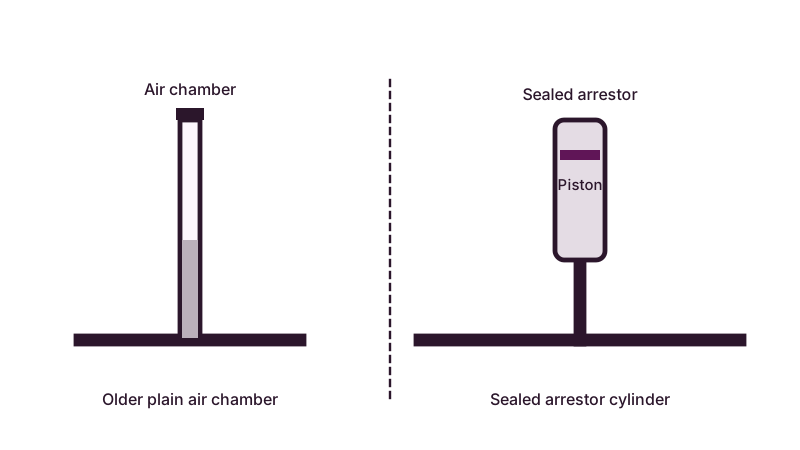
The California code has a water hammer section, and the source I read flags it as not adopted by the state housing department, so what applies to your home depends on building type and city. Do not assume a house must have arrestors. If knocking continues after the simple fixes, one at the noisy fixture, or at the main, is a common remedy.
The parts are cheap, but tying one into a supply line is plumbing work. In a finished wall it can mean opening drywall. A plumber normally quotes labor and part together and may check pressure on the same visit.
Could high water pressure be causing it?
Yes. The code in California asks for a regulator at static pressure above 80 psi, and extra pressure means a harder surge. A gauge screwed to a hose faucet outside gives the figure. Above 80, a regulator could quiet the house. A regulator that has failed may even be why the banging started.
High pressure rarely arrives alone. Look for a heater relief valve that weeps, faucets that spit or wear out early, and toilets that refill loudly. Low water pressure and valve work explains how these connect, regulators included.
With normal pressure and secure pipes, the remaining suspects are a worn valve, a waterlogged air chamber or a tired fill valve. A plumber can trace the noise by holding an ear to the wall while someone runs each fixture in turn.
Which signs mean the knocking needs a professional?
Arrange a visit when the banging shakes the wall, when a stain or drip shows near a pipe, when it began after other plumbing work, or when your own fixes did nothing. Repeated shocks loosen joints and eventually make leaks, so a hard bang is not something to live with for years.
Ask for the pressure reading, the source of the noise and a quote on paper first. California law wants a contractor license for plumbing past a small dollar limit. Request a quote and say which fixture triggers the sound. Requests are read weekdays, nine to five. For other prices see plumber cost in Torrance, or read about leak calls if water is showing.
Common questions
Can a banging pipe hurt anything?
A single bang is no emergency in itself. Repeated shocks, though, loosen fittings, strain joints and age valves and appliances. Violent hammering, or any hammering with a leak, deserves attention soon. Water on the floor? Close the main first, then phone.
Why does only one faucet make the noise?
Probably a fast-closing valve on that fixture, or a loose pipe near it. Single-lever faucets and appliance valves shut quickly. Try closing it gently and check the supply line. If the bang survives that, a plumber can fit an arrestor close to the fixture.
What does stopping the banging cost?
The cause sets the price. Strapping an exposed pipe costs little, a regulator or arrestor costs more, and opening a wall costs more again. Expect a range only after someone finds the source. How visit charges work is on the service call cost page.
Can high pressure make my pipes bang?
Yes. Higher static pressure means a stronger surge when a valve slams shut, and the code wants a regulator above 80 psi. Measure with a gauge first. If it reads high, a regulator may cut both the noise and the wear on every fixture in the house.
Sources used
Last updated