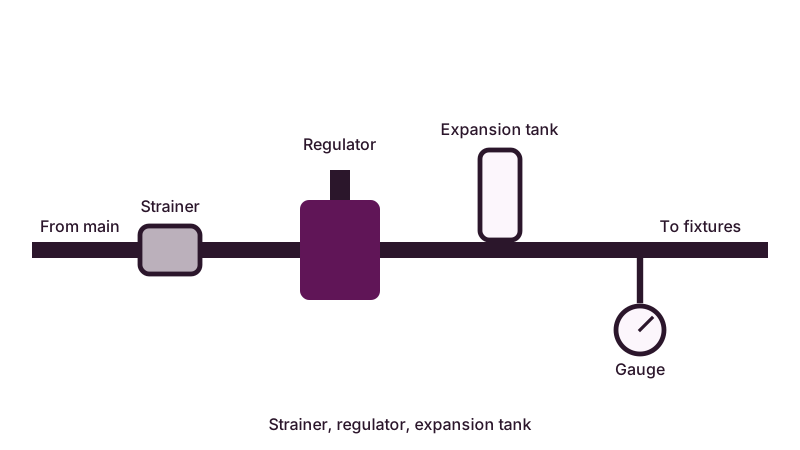
Think of a regulator as a brass bell on the incoming pipe that keeps street pressure from reaching your fixtures at full strength. Once its spring or diaphragm tires, pressure drifts up or sags. Related faults sit on the low water pressure hub; this page stays with the valve alone.
How does a worn-out regulator behave?
The valve fails in either direction. Too much pressure brings banging pipes, a heater relief valve that weeps, faucets and fill valves that die early, and taps that spit. Too little means weak flow at every fixture together. Only a test gauge on a hose faucet reveals which way it went.
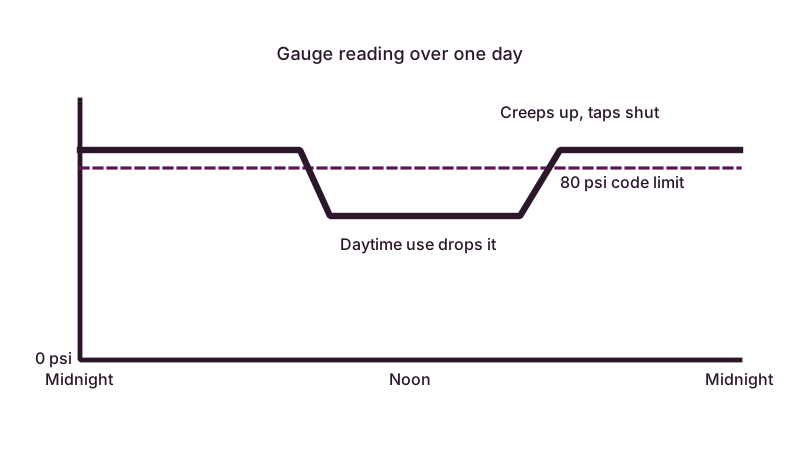
Eighty psi is the code's line. Under section 608.2, static pressure beyond that calls for a regulator with a strainer ahead of it, set to bring pressure to 80 or less. A reading far below what the house used to have, with the main fully open, makes the regulator one suspect among several.
Creep is another sign: normal readings by day, higher ones overnight while no water runs. That pattern means the valve cannot hold its setting. A gauge with a trailing needle that remembers the peak will show it by morning.
How do I find the regulator?
Follow the main line to the point where it comes into the house. You may find the valve in a garage, a utility room, the crawl space, or a box near the meter out front. Look for a brass bell a short way past the main shutoff, topped with an adjusting screw and lock nut. Some houses have none.
Ownership can be unclear. I could not confirm how the City of Torrance or the neighboring water suppliers handle pressure control, so ask your supplier before assuming a valve is yours. Anything on the supplier's side of the meter is off limits to you.
In older houses the valve may be buried in a landscaped box or boxed in behind a garage wall, and a plumber can trace it in minutes. If you cannot find one, there may not be one, and street pressure reaches your fixtures directly.
Should the regulator be adjusted, rebuilt or replaced?
A sound valve takes minutes to adjust. Free the lock nut, then rotate the screw gradually while the gauge shows the result. If pressure will not hold, or the body leaks, replace it. Rebuild kits exist, yet on old brass a fresh unit is usually the sounder buy.
Age and water conditions wear valves down. Regulators wear out over the years, so an original one from decades back is long overdue. Hardness varies across Torrance, and scale can foul a diaphragm or a strainer screen.
DIY stops short of the swap. Cutting into the main carries flood risk, and a permit may apply. Adjusting a working valve while watching a gauge is the one step a handy owner can take, while the plumber decides whether the setting suits your fixtures and pipe age.
What does a regulator replacement visit involve?
First a gauge reading, then the main closes and the old valve is pulled. The replacement goes in with a strainer where needed, an expansion tank is added or checked, pressure is set, joints are tested for leaks, and a final reading is taken. In an easy spot it is a short visit, and the written quote comes before any of it.
Mind the expansion tank. With a regulator holding pressure inside the house, heated water that swells has no escape, so an expansion tank is often needed on the cold line after the valve. Ask if your quote has one, and whether the water heater already carries one.
Also ask which pressure will be set and why, whether any permit is built into the price, and whether the new valve meets the standard the code names. Some cities want a permit for a swap, and Torrance's rule was out of my reach, so put the question to Building and Safety at city hall.
What does the swap run in dollars?
Published guides disagree widely on what a regulator replacement costs, so this page prints no national figure. Your own number appears in the quote you get after a visit, and it ought to itemize the valve, any tank and any permit. Access to the valve, pipe condition and any expansion tank all move the total.
Good quotes record pressure before and after, so you hold proof the work did something. Treat with caution any offer to swap the valve without measuring, since a regulator is not always the problem.
California wants a contractor license for plumbing past a small job size, so check the licensing board lookup before hiring. To start, request a quote with any gauge reading you have, the symptoms and your neighborhood. Requests are read weekdays, nine to five. How visits are charged is explained in the plumber cost guide, plus the service call cost page, and the Del Amo home page links to every other service.
Common questions
How long before a regulator wears out?
Regulators wear out over many years, with water quality and pressure deciding. Hard water, debris and sustained high inlet pressure cut it short. A valve that creeps past its setting, leaks at the body or whines is due, whatever its age.
Should an owner tackle the swap?
Adjusting a working valve needs only a wrench and a gauge. A swap means cutting into the main, where a slip floods the house, and a permit may apply. Most owners hire it out, especially where old galvanized pipe can crack when disturbed.
What setting should the new regulator have?
Eighty psi is the code ceiling, and plenty of plumbers set houses below it. The exact number is a judgment about your fixtures, pipe age and household needs, so ask the installer what they propose and why. Have pressure measured with a gauge once the work is done.
Does a new regulator mean an expansion tank too?
Frequently. An approved tank on the cold side downstream of a regulator is often needed, since heated water expands with nowhere to go once the valve blocks backflow. Some designed systems use approved relief valves instead, so ask which arrangement your house will get.
Sources used
Last updated