A rate card is only half a bid, so treat any hourly figure as a starting point. The guides we checked spread widely: one lists commercial work at $120 to $250 an hour, another at $90 to $200, another at $100 to $150 and up on time and materials. Our commercial plumbing page covers what the trade does, and this one covers what it bills.
What do commercial plumbers charge by the hour?
Published guides span roughly $90 to $250 an hour, and the middle of the field sits near $140 to $175. Residential work usually sits lower, near $75 to $150. Commercial runs higher because the pipe is larger, the code work is heavier, and buildings often need after-hours access. A local quote is still the only real number for a specific building.
Where a Torrance bid lands inside the band depends on four things: what the building is (an office, a restaurant, a warehouse), the pipe size and system, the hour of the visit, and repair versus new installation. Southern California labor can sit above national averages, so the upper half is possible.
What is the going rate by skill level, master or journeyman?
One range for a master plumber is $100 to $200 per hour, with $135 cited as common in many markets. Journeyman and apprentice time is billed lower, since a master mostly plans, supervises and handles code issues. A bid might mix both: a lead plumber plus a helper at a smaller rate, with the blended figure above the helper's rate alone.
Master and journeyman describe a person's training. The contractor license the state board issues, class C-36 for plumbing, belongs to the company. For a building owner the practical questions are whether the firm holds that license and who actually turns up on the job.
Why does an emergency or after-hours call cost more?
Because the standard rate gets a multiplier, any call outside normal hours is priced higher. Expect a premium near 1.5x to 2x the daytime figure, and holidays can reach triple. After-hours calls commonly run $150 to $300 an hour, and some firms add a separate call-out charge.
A broken main in a restaurant on a Friday night is the high end. A scheduled replacement at 10 a.m. on a Tuesday is the low one. If the problem can be stabilized (a shutoff valve closed, a bucket under the leak), waiting until the next business morning often trims the bill sharply.
What else adds to a commercial plumbing bill?
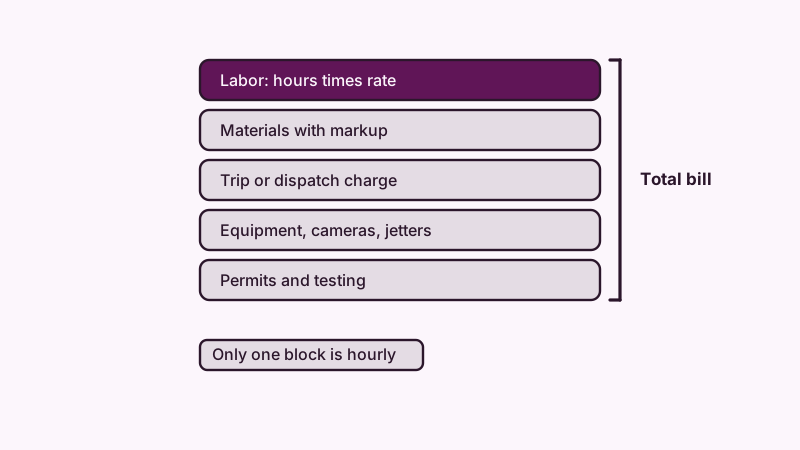
The hourly figure is rarely the whole invoice. A building owner should expect several other lines on a commercial bill, some fixed, some marked up, and some set by the city or the water supplier instead of the plumber. Asking about each before the work begins keeps the final total close to the estimate. The usual items:
- Trip or dispatch charge, often one hour of minimum.
- Materials, with a markup. Ask what percentage.
- Equipment, such as drain cameras, jetters, lifts and trench shoring.
- Permits and inspections, which the city building division issues.
- Testing, such as the yearly backflow test the water supplier asks for.
- Prevailing wage, on publicly funded jobs, where California's Department of Industrial Relations sets the wage floor.
Time and materials suits repairs where the scope is not known. For a defined installation, ask for a fixed price with a written scope instead, and compare it to an hourly estimate.
How do I compare two commercial plumbing bids?
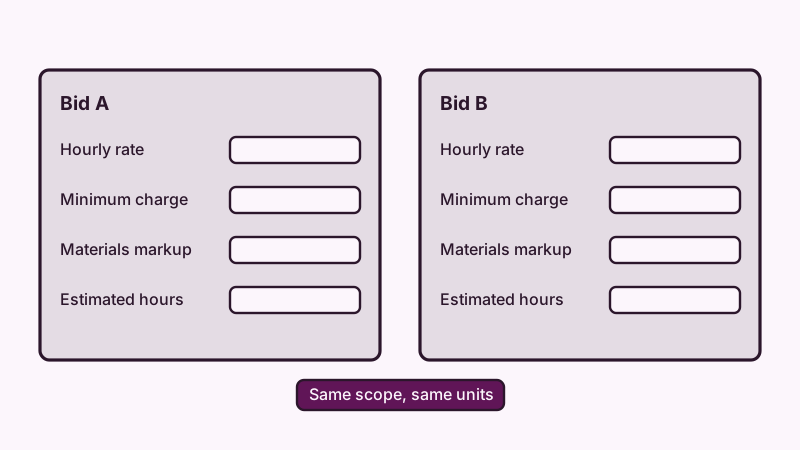
Ask both firms to price the same scope in the same units, then compare four numbers: the hourly rate, the minimum charge, the materials markup and the estimated hours. A bargain rate attached to long estimated hours or a fat parts markup can end up above a pricier rate with a tight scope. Ask whether travel time is billed.
Also confirm the basics before comparing: the contractor license, the insurance certificate if your lease requires one, and who pulls permits. The plumber inspection cost page shows what a fact-finding visit tends to run before a larger quote.
Is there a simple hourly rate calculator?
It fits on one line: multiply hours on site by the hourly rate, then add the trip charge, parts with markup, and any permit or test fees. A two-hour repair at $150 an hour, with a $150 trip charge and $120 in parts, comes to $570 in this made-up example. Adjust the numbers for after-hours or a larger crew.
Use the result as a sanity check on a bid, not as a replacement for one. The unknowns in any commercial job (access, pipe condition behind walls, tenant coordination) make a site visit worth more than a phone estimate. For the residential side of the same question, see the plumber cost overview.
Common questions
Does commercial work cost more than home plumbing?
Usually, yes. Guides put commercial at roughly $90 to $250 against about $75 to $150 for residential. The gap comes from larger pipe, stricter code, insurance expectations and after-hours access. Some firms charge the same hourly rate for both and add the difference in materials, so compare total bids, not rates alone.
How much is a commercial plumber's call-out fee?
Guides report widely varying call-out fees, with the higher figures for after-hours. A few firms deduct it from the bill once you approve the repair. Ask what it covers: travel only, or travel plus a set diagnostic time. A fee that includes the first hour is a better deal than a lower fee that adds hourly time on top.
What does a restaurant or office need that a home does not?
Backflow assemblies tested annually, grease interceptors in kitchens, larger drain lines, commercial water heaters and fixtures that meet accessibility rules. Each of these has its own inspection or service schedule. The plumber should know which apply to your building type, and your landlord's lease may split responsibility between tenant and owner.
Can I get a firm number without a visit?
Rarely. A phone estimate can cover a simple fixture swap, but drain, water-main or multi-fixture work needs eyes on the building, because pipe condition behind walls and access routes change the hours. The quote form is where to describe the building; a walk-through with written figures follows.
For what the work involves beyond the price, see plumber across Torrance.
Sources used
Last updated