Active faults run beneath Southern California, and one hard jolt can snap gas connections inside a house in seconds. A seismic shut-off valve is a mechanical device fitted just after the meter, on the property's own pipe; it closes by itself when it feels a quake of roughly magnitude 5.4 or larger. Below: how it works, who fits it, the price tag, and the reset routine. It sits within our broader work on gas lines in Torrance, and gas work belongs to a contractor, never a homeowner.
How does a seismic valve protect a house during a quake?
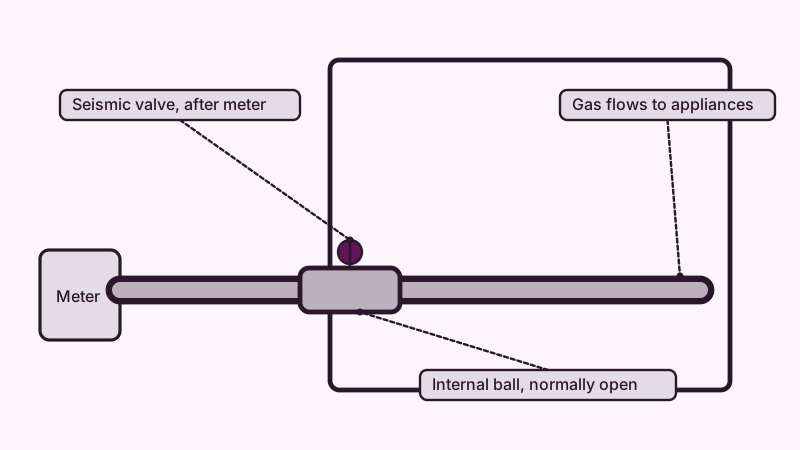
The valve is mounted on your gas pipe after the meter. Ground motion near magnitude 5.4 releases an internal ball or float, which drops into a seat and blocks the flow. Because it guards the house piping, a broken appliance hose or split fitting has nothing to feed.
There is a second device with a similar name that people mix up. The excess flow valve sits on the utility side underground and closes when flow suddenly surges, such as after a ruptured service line, whatever the cause. The Building America Solution Center describes the two as separate: the seismic valve is the homeowner's side and triggered by shaking, while the excess flow valve belongs to the gas company's side. Neither replaces the other, and neither is a leak detector.
Is a seismic valve required in Torrance?
Cities differ, and so does the type of project. Such rules tend to apply to new construction or significant alterations, not to every existing house. Torrance Building and Safety can say whether your project triggers one. Required or not, a valve is an option for any home with gas.
Ask the city rather than guess. The Torrance Building and Safety division lists its counter number as (310) 618-5910, and trade permits for plumbing and gas work go through its online system. If you are buying or selling, ask the agent whether the paperwork mentions a valve. Some insurers and lenders ask about earthquake protection, so it is worth a question to them too. A seismic valve is cheap compared with the damage from a fire after a quake, though it will not stop every kind of fire.
Who is allowed to fit a seismic gas valve?
In California the valve itself must carry state approval, and a plumbing contractor has to fit it as the maker directs. The Building America Solution Center cites the approval standard (Division of the State Architect Standard 12-23-1). Fitting one yourself is off the table: it is gas piping, and a poor fit can leak or trip falsely.
The plumber picks a valve sized to your gas load, fastens it on a straight, plumb stretch of pipe beyond the meter, and adds a stabilizing bracket if the maker asks for one so an accidental bump cannot trip it. The gas utility plays no role on the house side. Look the contractor up at cslb.ca.gov before agreeing, and file the invoice and maker's papers for resale day. Piping rules have their own page, gas piping codes.
What does a seismic gas valve cost?
The Building America Solution Center puts seismic valves at about $100 to $1,000, covering parts and installation. A basic install on easily reached pipe sits toward the low end; a tricky meter location, extra fittings or a permit can push it up. The plumber's written quote gives the actual number.
What changes the price: the valve model, pipe size, whether the existing pipe near the meter is straight and accessible, whether anything has to be moved or reinforced, and whether a permit applies. Mobile home parks, apartment meter banks and condominium gas lines can have extra rules, so ask the property manager first. For other gas jobs, see what gas line work costs.
What do I do once the valve has tripped?
A tripped seismic valve needs a hand reset, and only once someone has checked the house for leaks. Some areas let owners reset it; others involve the gas utility or a plumber. Do not relight appliances before that check. Gas odor? Leave and contact SoCalGas.
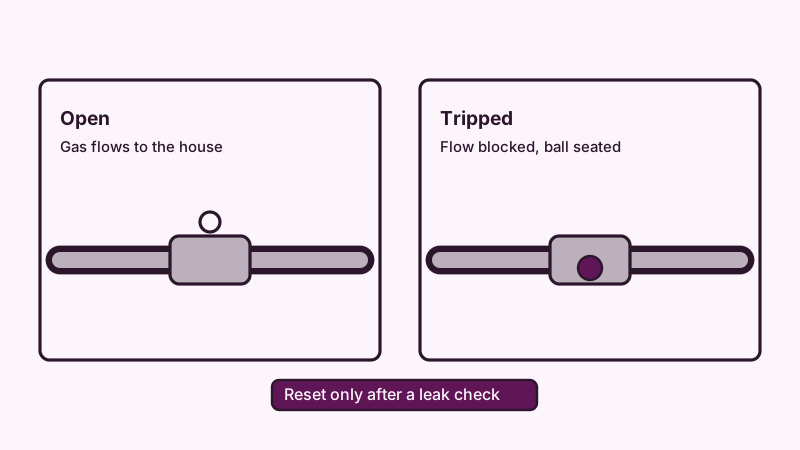
Reset steps differ by model, so the maker's sheet governs. After a quake, look outside before anything else. Hissing or a gas smell means everyone leaves the building, and only once you are well away do you phone SoCalGas on 1-800-427-2200; add 911 if anyone is hurt. A valve that tripped without any smell can be checked by a plumber before gas is restored. SoCalGas tells customers who close their own meter to leave it closed and contact SoCalGas to reopen it and relight pilots. More in resetting an earthquake gas valve.
Should I close the gas myself after a quake?
Close it only when you smell gas, hear it hissing or see another leak sign, and the meter is somewhere you can reach without risk. Otherwise SoCalGas asks customers to leave the meter alone, because restoring service takes time. If you shut it, the utility has to reopen it.
If the meter must be closed, follow the steps on SoCalGas's shut-off page. Avoid anything that sparks: lighters, switches, phone calls inside the building. Learn where your water main is as well, since quakes break water lines too. Water heaters carry their own quake rule, bracing or strapping spelled out in Health and Safety Code section 19211, which is separate from a gas valve; see our water heater repair page.
Who handles a gas leak, and who repairs the piping?
Pipe beyond the meter is the owner's, and a contractor has to repair it, while SoCalGas keeps the meter and everything upstream. Never patch gas pipe yourself. Repairs, replacements and new appliance hookups all count as permitted plumbing work handled by a contractor holding the state's license.
If a leak is suspected, treat it as urgent: get out, phone from a safe spot, and let SoCalGas and the plumber establish cause and repair. For new appliance hookups or line extensions, read about gas line work in Torrance, while the quote form gets a job going. Our home page has the full list of services, should you wish to look.
Common questions
What is the mechanism inside a seismic gas valve?
A weighted ball or float is held at rest inside the valve. Shaking near magnitude 5.4 or above knocks it loose; it falls onto a seat, seals the line and stops gas entering the house. It then remains closed until someone resets it manually.
What price should I expect for installation?
Building America Solution Center figures run from roughly $100 to $1,000, parts and labor together. Easy access and a single valve sit at the low end; awkward meter spots, extra fittings or a permit push it up. For your own house, trust the number in the plumber's written quote.
Is this a DIY job?
No. The state wants an approved valve put in by a plumbing contractor who follows the maker's directions, because gas pipe is regulated. A badly fitted unit can leak or trip falsely. Choose a contractor with a valid state license and verify it through cslb.ca.gov beforehand.
Will the valve stop gas leaks from other causes?
Not reliably. A seismic valve responds to shaking, not to a slow leak or a failed connector on a still day. Notice gas at any hour and everyone goes outside, then SoCalGas is called on 1-800-427-2200. A utility-side excess flow valve reacts to a sudden surge, never to a pinhole.
Does Torrance require a seismic valve?
It differs between cities and between project types, and requirements mostly bite on new builds or major alterations. Torrance Building and Safety can tell you what your address and job call for; the counter number is (310) 618-5910, or ask the plumber to confirm when pulling a permit.
Sources used
Last updated