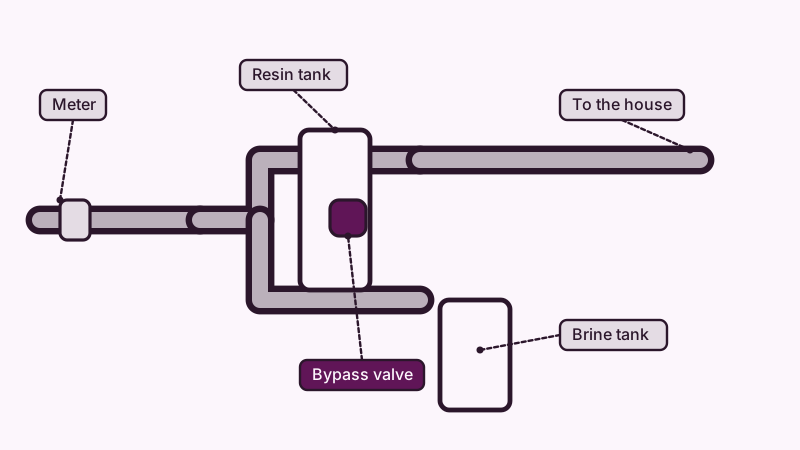
Short answer: yes, but only slightly when it works properly. A softener flushes itself, called regeneration, and that uses roughly 20 to 70 gallons a cycle according to dealer and manufacturer figures. At one cycle a week, that is a few hundred gallons a month, a small line on a metered bill. If your bill rose by much more, look for a fault: a valve stuck mid-cycle, a timer that regenerates every night or a leak unrelated to the softener. Your own water meter will tell you which, and the steps are below. If you are still weighing a purchase, the main guide to water softener installation in Torrance covers what the whole job involves.
What does the softener itself add to the water used?
Expect 20 to 70 gallons per regeneration, the low end for efficient demand-triggered models and the high end for older timer units. Most households regenerate once or twice a week, so the added use is a few hundred gallons a month. Those figures come mostly from dealers and makers, so treat them as ranges, not promises.
Three things move that number: resin tank size, whether regeneration runs on a clock or only once the resin is spent, and the hardness of the incoming water. Harder supply exhausts the resin sooner, which means more frequent flushes. Torrance supply is hard in most published figures, though the number depends on the blend of sources, so look at the latest report from Torrance Municipal Water for your own address before drawing conclusions.
What would make a softener use far more water than normal?
Four faults explain most freak readings: a timer regenerating daily, a unit that is oversized or badly set, a control valve that sticks and lets water run to waste, and a failed seal feeding the brine tank. Each can burn thousands of gallons over a billing period, quietly.
Put your ear to the drain line, a thin hose that ends at a floor drain or at the washer standpipe. Water flowing steadily when the unit is not regenerating means the valve is not seating. Check the brine tank too. If the water level in it keeps rising above the salt, water is entering when it should not.
Is it the softener, or something else?
Let the meter decide. Close every tap, stop the washing machine, dishwasher and ice maker, record the dial and come back in two hours. Movement means water is escaping. Next, flip the softener into bypass and repeat the wait. A still dial blames the softener; a moving one sends you hunting elsewhere.
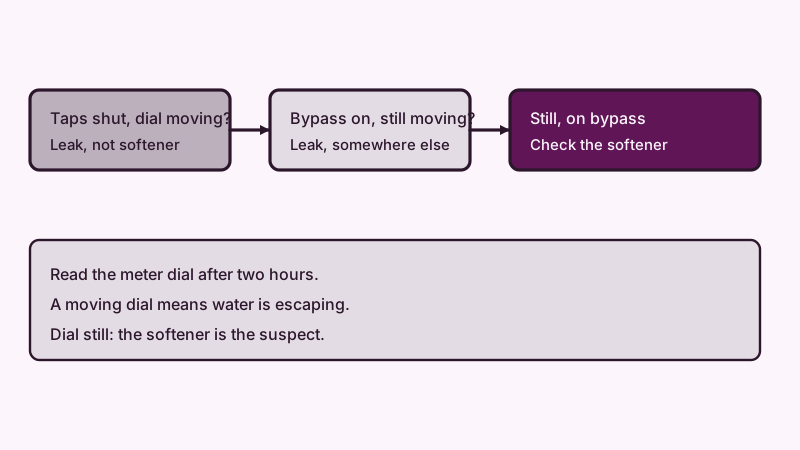
The EPA recommends the same two-hour wait for finding household leaks, and its figure is more than 9,300 gallons lost a year in the average home, so leaks often explain a shocking bill. Most meters carry a little spinning triangle or dial that moves with any flow, so even a slow leak shows quickly.
Does softened water make people use more water?
It can. Soft water lathers easily and leaves skin feeling slick, and some households notice longer showers or run the washer more often. There is no solid data to put a figure on it, and the effect is small compared with a fault. If your bill rose a lot at about the time the softener went in, a leak or a valve problem is the likelier cause.
Against that, softened water keeps scale out of pipes and water heaters. Water heaters that scale up use more energy and fail sooner, which is a different cost than the water bill. See hard water scale prevention for what scale does, and removing hard water scale for what can be undone.
What else raises a water bill besides the softener?
Think of the running toilet, the dripping tap, a sprinkler system with a broken head or stuck valve, and a hidden leak in a buried line. A silent flapper leak in a toilet tops the list and can lose thousands of gallons monthly.
Your bill also moves with the billing cycle length, rate changes and seasonal watering. For more suspects, open what pushes a water bill up. Drips add up faster than most people guess, as the leaky faucet bill page shows.
When is a plumber needed?
Book a visit if bypass shows the softener sending water down the drain, the control valve will not seat, or the dial moves and you cannot trace why. Moving or replacing a softener, changing its drain connection and tying it into the plumbing is plumbing work, and a new softener has to meet local drain rules.
Costs and the install itself are in water softener installation cost and whole-house softener installation cost. For the how-to side, see salt-based softener installation. If you are on a municipal supply, ask the supplier whether any local rule limits self-regenerating softeners before you buy.
Common questions
Will a new softener raise my bill right away?
Slightly, since it flushes itself with water each cycle. Published estimates for a typical household sit near a dollar or two a month, though your rates and settings shift that. If the first bill after installation is far above normal, check for a leak at the new connections.
How often should a softener regenerate?
Often enough to keep the resin working, and no more. Demand-triggered models decide for themselves from how much water you have used. Timer models regenerate on a schedule, so they can run when there is no need. Ask the installer to set it for your household size and your water's hardness.
Does a softener also filter my water?
No. Hardness minerals are swapped for sodium or potassium, while chlorine, lead and bacteria pass straight through. Those need a separate filter. If better drinking water is also a goal, ask about a dedicated system instead of leaning on the softener.
How long does a softener check run?
The bypass meter test is mostly waiting, around two hours. Inspecting the valve, drain hose and brine tank is under thirty minutes. If a repair or swap follows, its time estimate goes into the written quote, along with the price, so you can plan the day around the water being off.
What do I ask before booking?
Find out what gets tested before anything is replaced, who makes the drain connection, how the unit is programmed for your hardness and household size and what happens if the control head fails. Ask also whether salt, haul-off and permits are separate lines.
The rest of our guides start from plumber across Torrance.
Sources used
- U.S. EPA WaterSense, Fix a Leak Week (household leak figure and the two-hour meter test)
- Published softener maker and dealer figures on regeneration water use, typically 20 to 70 gallons a cycle, read November 2026 (plain label, vendor sources)
Last updated