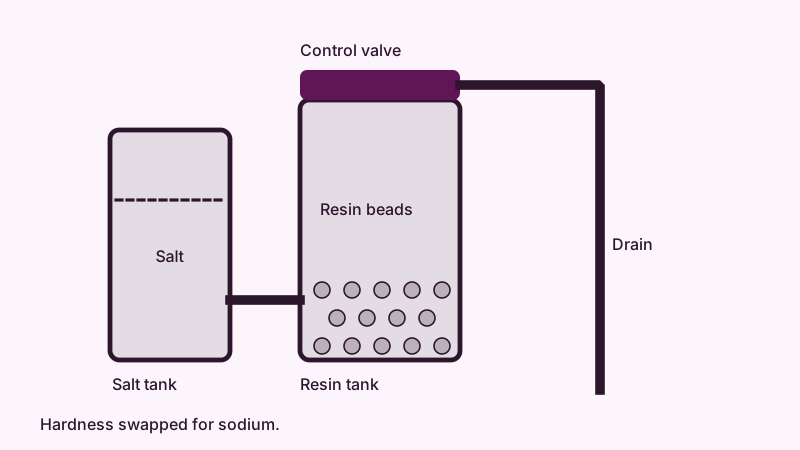
For a whole-house softener, budget roughly $1,100 to $3,000 installed, according to Fixr's guide, averaging close to $2,500 nationally, with outliers from $600 up to $7,000. The spread comes from the system type, the plumbing layout and whether a bypass loop already exists. Reading a quote well means knowing what each line buys, and our water softener installation service page explains the work behind these numbers.
What should a softener installation set me back?
An ion-exchange softener typically costs $650 to $3,000 installed, from Fixr's table of unit price plus labor, with labor alone at $150 to $1,000. Single-tank units sit at $650 to $1,500 and dual-tank units at $1,500 to $3,000. Your quote may differ; take these as a rough guide.
| System type | Unit price | Typical installed total |
|---|---|---|
| Magnetic descaler | $200 to $400 | $250 to $550 |
| Electronic descaler | $200 to $600 | $250 to $750 |
| Ion exchange (salt-based) | $500 to $2,000 | $650 to $3,000 |
| Reverse osmosis | $1,500 to $1,800 | $2,400 to $3,100 |
Fixr's national figures, read in November 2026. Note that magnetic and electronic descalers condition scale rather than remove hardness minerals the way ion exchange does, so their lower price is not like for like.
Which factors push the installation price up or down?
The main drivers are the type and capacity of the unit, whether a bypass loop is needed, the distance between unit, water main and drain, the electrical outlet, and the brand. Add permits, and the price of a salt-free alternative if you choose that route.
Capacity should follow household size and water hardness. Cal Water's 2025 report for its Hermosa-Redondo system lists local groundwater at roughly 486 to 517 ppm total hardness, with imported supplies lower, their plant averages running from about 88 to 236 ppm. Your supplier's report, which comes with your water bill, tells you which applies, and a plumber can test a sample at the tap. A garage install near the main is simpler than a unit in a finished closet, and a softener needs a drain for regeneration water, so check where the discharge goes.
How much does adding a bypass loop add?
A loop, in softener terms, is a short run of pipes and valves that lets you bypass the softener for service and gives the unit a clean connection. If your home does not have one, Fixr gives $600 to $2,000 to add it. Some homes already have a capped loop in the garage from the builder.
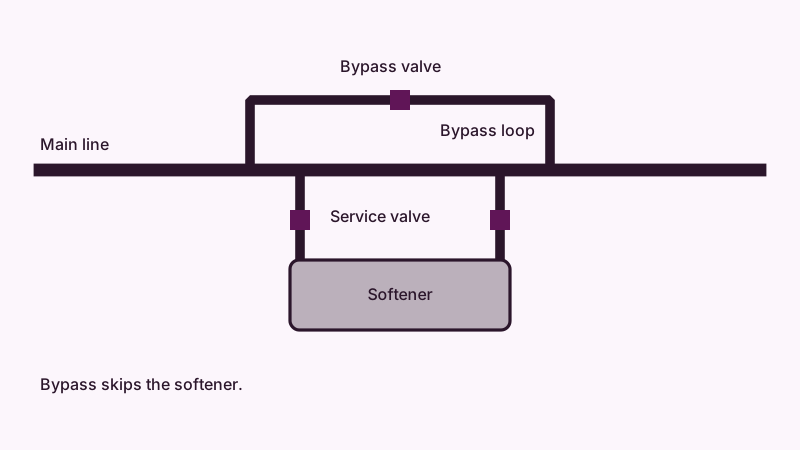
Have the plumber inspect the main line ahead of quoting. A plumbed loop is also where the installer ties in a drain and, if wanted, a hard-water outdoor tap, so garden irrigation does not run soft water. For the step-by-step on a typical job, see how a softener installation goes.
Do big names like Kinetico, Culligan or Rheem cost more?
Fixr lists unit-only ranges of $500 to $5,000 for Kinetico and Culligan, $300 to $4,000 for Rayne, $500 to $1,800 for Sterling and $1,700 to $2,500 for RainSoft. Installation is extra, and we found no published price for Rheem or AquaSure softeners, so ask the plumber or dealer for a written quote.
Retail offers bundle installation: Fixr shows Lowe's installed softeners at $1,000 to $2,800, The Home Depot at $2,500 to $6,000 and Costco's EcoWater units at $4,000 to $6,000. Those are installed-price bands and often include the dealer's own installer. A plumber can fit a unit you bought elsewhere, but check the warranty terms, since some brands require their own dealer. Compare like for like: capacity, regeneration type, and warranty on the tank and control head.
Is there a cost calculator I can use?
A simple estimate is unit price plus labor plus loop plus extras. Start with the capacity you need, add Fixr's labor figure, $150 to $1,000, add $600 to $2,000 if there is no loop, and add salt and upkeep. A plumber's site visit replaces guesswork with a firm number.
Running costs matter as well. Fixr cites salt at $10 to $15 a bag and operating costs of about $10 to $40 a month, with maintenance of $150 to $600 over time and rentals at $25 to $50 a month. Wondering about the effect on your bill? See if a softener can lift your water bill.
Do any local rules restrict salt-based softeners?
Possibly. Section 13148 of the state Water Code lets certain local agencies running community sewer systems limit self-regenerating softeners that discharge brine, once a regional water board has made a finding. The South Coast region is among those covered. Torrance specifics vary, so ask the city or your sewer agency before buying.
Where such rules exist they can require high-efficiency units, a permit, or a ban on new installs, and the law says an agency that orders removal of existing units must offer compensation. This page does not claim that any rule applies at your address. Ask the city Building and Safety division, and ask the plumber whether a permit is needed. If you want to avoid salt, a descaler or a portable exchange service are routes to ask about, and salt-based softener installation explains the standard setup.
Should I buy a softener, or is there a cheaper fix?
If hardness is the only problem, a softener is the usual answer, but cheaper steps help for specific symptoms: descaling kettles and showerheads, flushing a water heater, or fitting a filter. A softener makes sense when scale is clogging fixtures, shortening appliance life and leaving spotting everywhere.
Our pages on preventing hard water scale and removing hard water scale cover the options before you spend. For a whole-house system sized by a plumber, see whole-house softener installation cost, and send a request via the quote form; other services are described on the home page if you are curious.
Common questions
What will the softener and its installation cost me?
Fixr's guide shows $1,100 to $3,000 installed for most systems, with $2,500 as the national average. Labor runs $150 to $1,000, and a loop adds $600 to $2,000 where there is none. Local prices and your plumbing change the total, so rely on the written quote.
Can a plumber install a softener I bought myself?
Usually yes, if the unit is in good order and the plumber is willing to connect it. Confirm the manufacturer's warranty does not require a particular installer, and ask who is responsible if the connection leaks. The plumber will still need a drain and a nearby outlet.
How much time should a softener installation need?
Most installs take a few hours to a day, depending on whether a loop exists and the distance from the unit to main and drain. Adding a loop takes longer, since pipe is cut and rejoined. A time estimate comes with the quote.
Does a softener need a permit?
It may, since it involves modifying plumbing, and some local rules apply to softeners specifically. Torrance handles plumbing permits via its Building and Safety office, and the plumber normally checks and files whatever is required. Raise it before the job begins, not once it is finished.
Is hard water bad for me?
Cal Water's report notes hard water is generally not a health concern, but it affects soap lathering and can leave mineral buildup in pipes and water heaters. That buildup is the reason people install softeners, and the reason heaters should be flushed. If you have a health condition, ask your doctor about sodium in softened water.
Sources used
Last updated