Repiping fits the case where the whole network is tired, not one spot. Four culprits recur: rust-choked galvanized steel, polybutylene with a failure record, copper that keeps sprouting pinholes, and water that arrives weak or brown. The job itself is described in repiping a house; here you get the reasons and the timing.
What makes a house need new supply pipes?
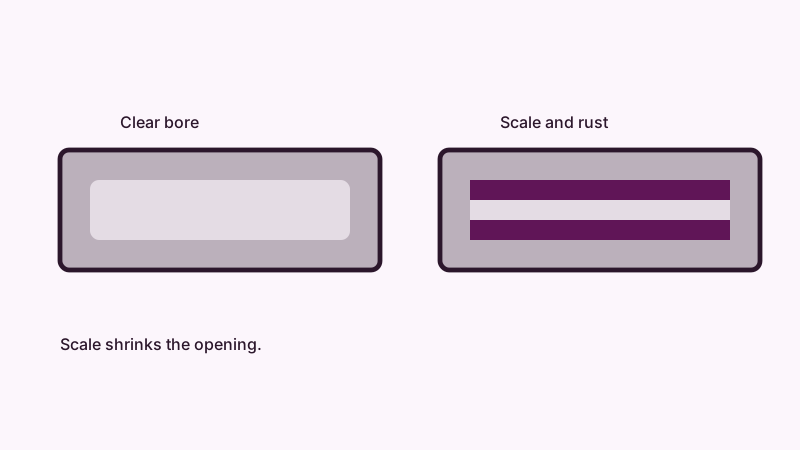
Wear starts inside the pipe. For decades water scales, dissolves and pits the metal until walls thin and burst or the opening shrinks. Replacement is sensible once that wear is everywhere: several leaks close together, rust at multiple taps, or a material with a bad track record. A lone leak on a healthy line usually gets a simple fix.
Four material stories explain most South Bay repipes:
- Galvanized steel. Common in houses built before about the 1960s. The zinc coating wears off, rust builds inside, flow drops, and fittings seize.
- Polybutylene. Gray or blue plastic piping, installed from the late 1970s into the mid-1990s, with a history of splitting at fittings. See polybutylene replacement.
- Thin-wall copper. Sound for decades, but pinhole leaks can start where water chemistry attacks the pipe.
- Old lead solder. Federal rules banned lead solder in drinking water plumbing in 1986, so a house built before then may have it at copper joints.
How do I know the pipes are failing?
Watch for patterns, not one-off events. Flow that has faded for years, brown water at first draw, pinholes number two and three, green crust on copper joints, ceiling stains under a bathroom, a bill that creeps up unexplained. Alone, each has other causes. Several together implicate the pipe.
Try a walk-around test: run the cold tap at every sink and tub and compare. A strong kitchen and a dribbling far bathroom suggest a restriction in that branch. The low pressure guide lists simpler causes first, such as a closed valve or a bad regulator.
Visible pipe in the garage or under a sink tells part of the story. If it is galvanized, covered in bluish-white crust, or gray plastic stamped PB, the walls hold more of the same.
Is it cheaper to patch each leak or to repipe once?
Patch when the pipe is still healthy and the leak has a clear cause. Replace when leaks keep returning. Every repair carries a visit fee plus wall patching, so by call three or four the total starts to rival a replacement. A plumber who has seen inside your walls can say where your house falls.
Guides we read start a whole-house job near $3,000 for a small home and climb well past $10,000 for a large one, and one Orange County plumber cited $13,000 through $18,000 for full PEX. Square footage, fixture count, wall access and finish repair set your number. Line-by-line numbers are in what a repipe costs, with a PEX-only view in PEX repipe pricing.
Weeping pipes also waste water. EPA WaterSense counts a typical household losing over 9,300 gallons yearly, so a slow leak costs money long before anything stains.
What material replaces the old pipe?
Most South Bay repipes today use PEX or copper. PEX tubing flexes around corners, so it needs fewer joints and smaller openings. Copper is stiffer, costs more and has a long record. Water chemistry, budget and the installer's preference all play in. The PEX and copper comparison sets out the trade.

For houses with hard water, which describes much of Torrance's supply from mixed local and imported sources, copper can still pit in some conditions. PEX does not pit the same way, but sunlight and certain chemicals can harm it. Ask a plumber who works your neighborhood what they see locally, and check the water quality report your supplier publishes for mineral numbers.
How disruptive is a repipe?
A typical house takes a few days. Crews cut modest openings in walls and ceilings, pull new lines through, reconnect each fixture and pressure-test before closing up. Expect the supply off for part of each working day. Drywall patching and paint often belong to other trades, so check what the bid covers. Bathrooms and kitchens determine the amount of wall work.
Plan for the household: showers, dishwasher and laundry may be unavailable during the day. Many owners arrange to stay elsewhere for a night or use a gym. Older houses get their own treatment in replacing the plumbing of an old house.
Which South Bay houses come up for repiping most?
Older ones, and the era tells you what is in the walls. Postwar tract homes in Torrance, Gardena and Lawndale got galvanized steel or early copper, so both rusted flow and pinholes show up there. Cottages and apartment buildings in the beach cities can mix several generations of pipe after piecemeal remodels, and an odd patchwork is itself a reason to open a wall and look.
Houses from the polybutylene years, roughly the late 1970s through the mid-1990s, are a separate group: that plastic was cheap, widely used in new subdivisions, and prone to splitting at its fittings.
Common questions
Does a repipe raise a home's value?
It removes a known risk, which buyers and insurers care about, and some insurers load premiums or decline cover when a house has polybutylene or galvanized supply. A repipe does not usually pay back its full cost in sale price, but it can make a sale smoother. Ask your insurer and agent what applies to your policy.
Can I repipe just part of the house?
Yes. One branch, say the kitchen and bath lines, can be swapped while healthy sections stay put. The trade-off is that a partial job leaves old pipe in the walls that may fail later. A camera or pressure test on the remaining pipe helps decide.
Does repiping involve city paperwork?
Generally. Swapping supply lines is plumbing work the city building division expects to inspect, and the contractor usually applies for it. Ask whose name is on it and keep a copy. Contractor licensing rules apply above a small job size in California, so verify the contractor's number before hiring.
How old is too old for the pipes?
There is no single date. Galvanized steel often shows trouble after several decades, copper can last far longer, and polybutylene fails more by type than by age. Look at condition: leaks, rust, pressure and water color. A plumber can test pressure, inspect visible pipe and cut a small sample to see how thick the walls still are.
For the wider picture, start with plumber torrance.
Sources used
- EPA WaterSense, Fix a Leak Week
- Published repipe and pipe replacement guides from plumbing cost sources, checked November 2026
Last updated