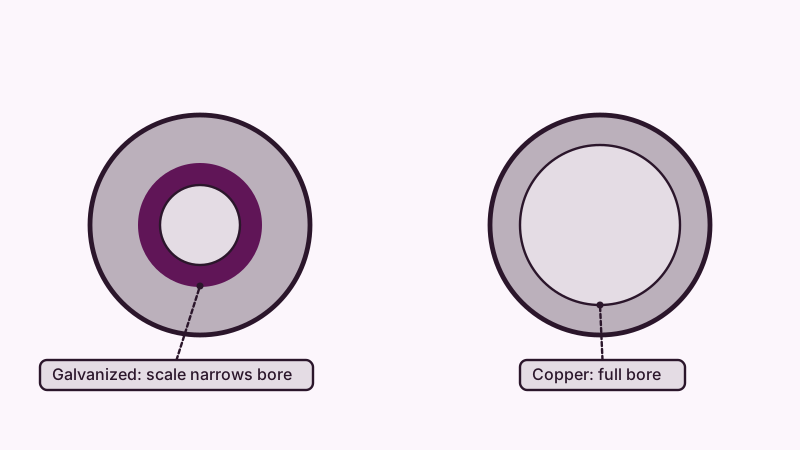
Zinc-coated steel, known as galvanized pipe, carried household water for decades. The coating delays rust without ending it: the pipe corrodes from within, scale narrows the bore, and eventually the wall gives way. Replacement means substituting PEX, copper or CPVC runs. That is a bigger commitment than a typical fix, which is why our overview of repiping a house frames it, and this page deals with the galvanized specifics.
What is the usual lifespan of galvanized pipe?
Roughly 40 to 50 years is the figure usually quoted for galvanized supply pipe, with water chemistry, workmanship and usage moving it either way. Wikipedia describes steel pipe rusting inward and growing plaque that cuts pressure and finally produces failure.
Original galvanized lines in a 1950s or 1960s house have outlived that window. Postwar South Bay tracts commonly used galvanized or copper supply lines, though many have been partly or wholly replaced since, so a mix is possible. Hardness feeds scale: Cal Water's 2025 report for Hermosa-Redondo gives groundwater an average near 502 ppm, though your own supplier's report is the one that applies. House age alone proves little, since earlier owners may have repiped; a plumber can identify what you actually have.
How do I know I have galvanized pipe?
Galvanized pipe is gray, dull silver or rusty, threaded at joints, and magnets stick to it. Copper looks reddish brown, and a scratch test shows shiny metal. Plastic pipes are white, red, blue or gray. Look where the pipe comes out of the wall, at the water heater and near the main shut-off.
Check at the water heater connections and under sinks. Brown water when a tap first opens, pipes that feel rough at the threaded fittings, and a flow that has slowly dwindled all suggest rust inside. A magnet that clings to the pipe confirms steel, though a plumber should confirm by looking. Galvanized pipe is sometimes mixed with copper, which can cause its own corrosion where the two metals meet without a proper dielectric fitting.
Which symptoms say it is time to replace galvanized pipe?
Dwindling water pressure, rusty or brown water, a metallic taste, repeated joint leaks, pinholes and flaking rust around fittings are the main warnings that galvanized pipe is nearly spent. Bob Vila names corroded galvanized pipe among the causes of house-wide low pressure in older homes.
When just one fixture is weak, a clogged aerator or showerhead is likelier, and Bob Vila suggests cleaning those first. With every fixture weak and old steel pipe in the walls, internal rust is the prime suspect because it narrows the flow path. Pressure at an outdoor tap tells a plumber a lot, and a short cut-out section shows what the pipe looks like inside. To clear single-fixture causes first, see why shower pressure is low. A run of leaks means failure across many spots, and patch after patch ends up costing more.
What does replacing galvanized pipe cost?
Bob Vila's guide puts whole-house repipes anywhere from $1,500 up to $15,000, with a $7,500 national average. Pipe alone runs $2 to $8 per foot for copper, $0.40 to $2 for PEX and about fifty cents to a dollar for CPVC, and drywall repair is extra. Only the quote you are handed fixes the real figure.
| Item | Typical figure |
|---|---|
| Whole-house repipe, national | $1,500 to $15,000 (average $7,500) |
| Three-bedroom, 1,500 sq ft house | $2,280 to $5,120 |
| Copper pipe, per foot | $2 to $8 |
| PEX pipe, per foot | $0.40 to $2 |
| CPVC pipe, per foot | $0.50 to $1 |
| Plumber labor, about 15 hours | $675 to $3,000 |
| Drywall repair, per square foot | $50 to $75 |
Those national guide numbers, read in November 2026, leave out local conditions; access, finished walls and fixture count drive the final bill. For the money side read what a repipe costs and galvanized pipe replacement cost.
Should I choose PEX, copper or CPVC?
PEX is the common repipe choice now: flexible, easy to route through walls with less demolition, and cheaper by the foot. Copper is stiff and heat-tolerant, lasts long, and costs more. CPVC undercuts copper but is more brittle. Bob Vila lists lifespans of 80 to 100 years for PEX and 50 to 100 for copper.
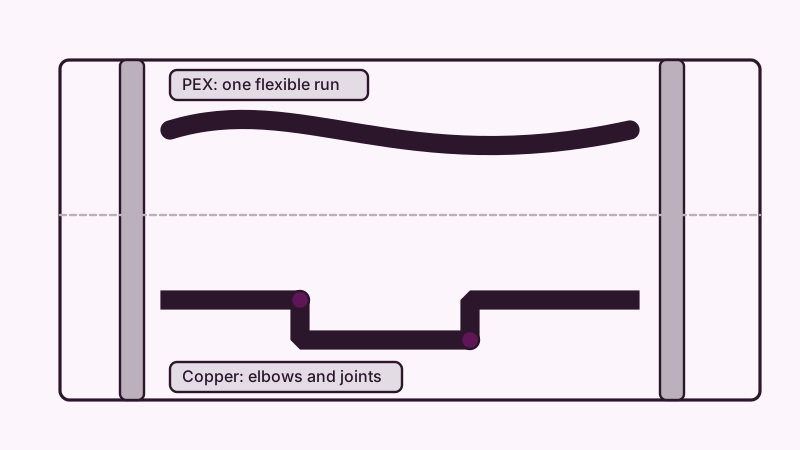
Material also depends on water chemistry and the plumber's preference. California's plumbing code approved PEX for statewide use, and plumbers across the region use it. For a head-to-head, read PEX versus copper. Mixed jobs happen too: replace the worst runs and leave sound copper in place. Ask the plumber for the reasoning behind a material choice, not only the choice.
What is the timeline for repiping a house?
It hinges on house size, fixture count, access and how much wall is opened. Bob Vila cites about 15 hours of labor on a typical job but gives no overall duration. The quote should lay out a schedule, the daily hours without water and how walls get patched.
Expect interruptions to your water most days, followed by drywall and paint work. Crews that cut access holes should arrive with a patching plan, and patching is sometimes a separate trade. If awkward pipe lengthens the job, the quote should say so. Ask when you can use water during the day and whether the heater is reconnected each evening. For old-house budgets generally, see the cost of redoing plumbing in an old house.
Does Torrance require a permit for repiping?
In general, yes: repiping is permitted plumbing work. Torrance Building and Safety processes plumbing permit applications and states that trade permits need their own applications. The plumber usually files, and an inspector checks the result. Ask who is doing the filing, and steer clear of anyone suggesting you skip it.
The state contractors board notes that construction work needs sign-off from the local building department and that rules vary by place, so confirm with the city on (310) 618-5910. Leaving out the permit can cause headaches when the house is sold or a claim is filed. A job this size also calls for a plumber carrying a state contractor license, which you can verify on cslb.ca.gov.
How do polybutylene, copper pinholes and clamps fit in?
Polybutylene went into many houses between about 1978 and 1997 and often fails at fittings; Wikipedia says replacing the plumbing throughout is the only long-term cure. A class action over it settled, though whether any program is open today needs confirming. Copper pinholes can be clamped for a while.
Either a clamp or a push-on coupling can halt a small copper leak for now; for something lasting, a plumber can fit a proper coupling with no soldering. Mending one pipe in a failing system just shifts the leak elsewhere. See polybutylene pipe replacement and repairing a pinhole leak. A repipe quote starts at the quote form, and the home page is there should you want to see other services.
Common questions
Will a clamp hold on a copper pipe?
Yes. A padded repair clamp can seal a small pinhole or split in copper for the time being. Think of it as time bought, not a lasting repair. If a section is corroded or keeps leaking, a plumber can cut it out and fit a coupling, or replace the whole run.
Can copper be repaired with no soldering?
Yes. Push-fit and compression couplings connect copper without a torch and suit tight or wet spaces. Prepare the pipe: clean, round, cut square. Fittings like these are accepted for lasting use when installed per the maker's directions, though a plumber should fit them where they will be hidden.
What will replacing galvanized pipe run me?
In Bob Vila's guide a whole-house repipe spans $1,500 to $15,000 with $7,500 as the nationwide average, while some 15 hours of plumber labor is $675 to $3,000. Per foot, PEX is $0.40 to $2 and copper $2 to $8. Wall repair comes extra, and your quote is the final word.
Will new pipe cure weak water pressure?
Often, if internal rust is the cause, because new pipe restores the full bore. Pressure can also sag from a tired regulator, a valve left part-shut or a leak, so the plumber should measure pressure and inspect before quoting a repipe.
Is there a polybutylene pipe replacement program?
A class action over polybutylene plumbing settled years ago, according to Wikipedia, but we cannot confirm any current program. Ask your insurer, the city and a plumber, and do not rely on one existing. If you have polybutylene, a repipe quote is the sensible first step.
Sources used
- Wikipedia, Galvanization (zinc coating, inside-out corrosion, 40 to 50 year life)
- Wikipedia, Polybutylene (use from about 1978 to 1997, failure at fittings, class action)
- Bob Vila, cost to repipe a house (per-foot and whole-house ranges), checked November 2026
- Bob Vila, low water pressure causes and fixes (galvanized corrosion)
- City of Torrance, Building and Safety permits
- California Contractors State License Board, building permit requirements
- Cal Water, 2025 water quality report for Hermosa-Redondo
Last updated