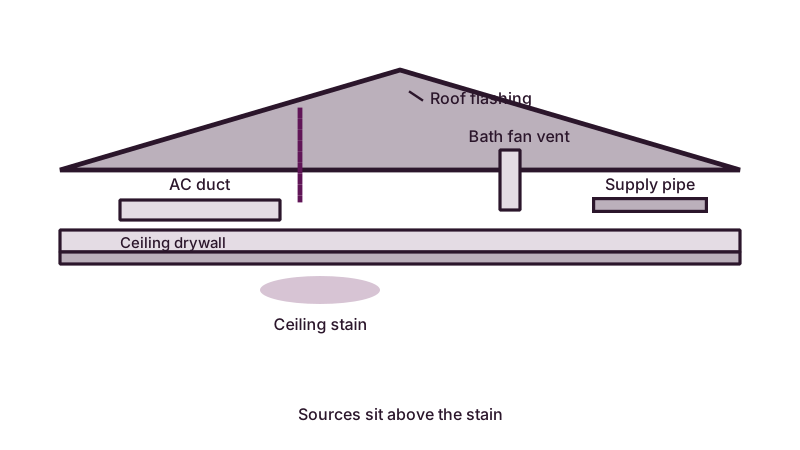
Four sources explain most dry brown patches: a one-off leak long since dried, moisture forming on cold ducts or pipes, a slow leak that appears only after water is used, and roof or attic trouble that waits for rain. Your first job is learning whether the mark is spreading. This page sits under our hub on plumbers for leaks in Torrance.
Can a ceiling water stain appear without an active leak?
Yes. Water that came through once and stopped leaves a stain that stays, because drywall and paint hold the mineral and tannin marks after the water has dried. A one-time overflow, a roof leak from a storm, a fixed pipe or a leaking tub upstairs can leave a mark that never changes. The stain is the record of a past event, not proof of a current leak.
The test is time and a pencil. Draw a light pencil line around the stain's edge and note today's date beside it. Check it after a rain, after the upstairs shower has run, and after a week. An outline that stays put on a hard, dry surface suggests the leak is old. If it grows, softens, bubbles the paint or smells musty, something is wet now.
Look for these differences:
- Old, dried stain. Sharp brown edge, dry and firm to the touch, no change over weeks.
- Active slow leak. Soft or sagging drywall, a ring that widens, paint that bubbles, a damp smell, or a stain that darkens after water use.
- Condensation. Droplets or dampness that come and go with humidity or when the air conditioning runs.
What causes ceiling spots when nothing is dripping?
Candidates include a dried-out earlier leak, air conditioning ducts that sweat or a blocked condensate line, poor attic ventilation, roof leaks that show only in heavy rain, a bath fan exhausting into the attic, and a slow supply or drain leak overhead. Each leaves a similar-looking mark, so the location and the timing separate them.
Common sources and how they show up:
- Plumbing above. A bathroom, laundry or kitchen over the ceiling, or supply lines in the attic. The stain darkens when that fixture is used.
- Air conditioning. Ducts in the attic can sweat in humid weather, and a clogged condensate drain line from the unit can overflow. Spots appear near vents or along duct runs.
- Roof. A flashing, vent or tile failure lets water in during rain. The stain appears or spreads after storms and dries between them.
- Bathroom exhaust. A fan that ends in the attic instead of outdoors puts warm, wet air against cold roofing.
- An earlier leak. Paint over a stain can hide it, and it may bleed through again when humidity rises.
Which trade fits: a plumber for pipes and fixtures, a heating and air contractor for ducts and condensate lines, a roofer for roof leaks. We arrange plumbers, so we start by finding out whether water is moving through your pipes.
How can I check whether the plumbing is leaking?
Read your water meter. EPA's WaterSense program describes a simple meter test: record the dial, run no water for two hours, then look at the dial again. If the dial has moved, water is escaping somewhere in the house. Then check fixtures above the stain: look under sinks, around the toilet base and behind the tub for damp, and run each fixture while watching the ceiling.
More checks that cost nothing:
- Drop some food coloring in each toilet tank. Dye that reaches the bowl within ten minutes marks a silent leak that never reaches the ceiling but still turns the meter.
- Run the upstairs shower for a few minutes and see whether the stain darkens.
- Feel the wall below the stain for warmth, which can mean a hot water line.
- Look at the drain trap and the shower pan above the spot for seeping caulk or grout.
A meter that does not move and a stain that does not change point away from plumbing. If the dial turns when no tap is open, some water is slipping out unseen; other explanations are collected in high water bill causes.
Is it condensation, and how do I tell?
Condensation is moisture from humid air forming on cool surfaces, such as air conditioning ducts, uninsulated cold water pipes, or a ceiling under a poorly ventilated attic. It leaves damp patches, sometimes with drips, that follow the weather. It appears in humid or cool conditions and fades when the air dries, with no change in your water meter.
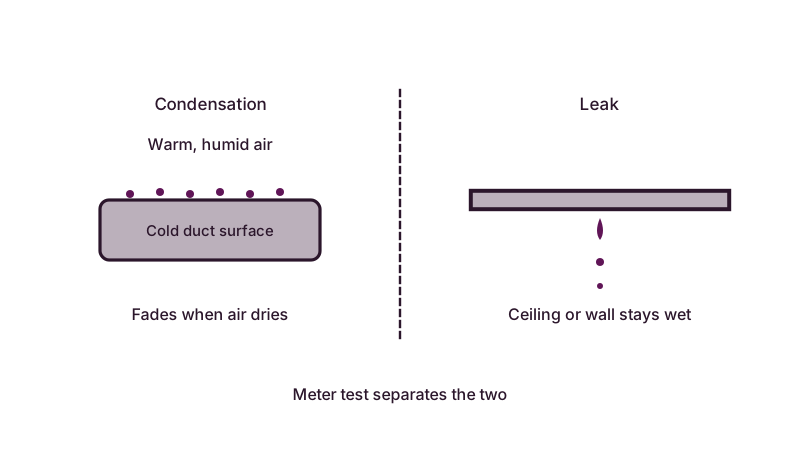
Clues: spots that line up with a duct run or a vent; dampness on cold days or when the air conditioning has been running; a musty smell without any visible pipe. Fixes belong to the ducts, insulation or ventilation. Do not paint over a damp stain, because paint traps moisture.
If you see dampness in several rooms, or on exterior walls, the water may be coming from outside. A roofer can check flashing and vents, and a gutter that overflows near the wall can wet it too.
Can a dry stain still signal trouble?
Take it seriously when the drywall is soft, the stain is growing, a musty smell or mold has appeared, or the spot hangs beneath a bath, a kitchen or the laundry room. Damp materials can grow mold within 24 to 48 hours, according to the Wikipedia overview of water damage, so a slow leak behind a ceiling should be found, not painted over.
Wikipedia's summary of water damage also advises drying wet areas within 24 hours and keeping indoor humidity below 50 percent. An old, dry, unchanged stain can be sealed with stain-blocking primer and repainted. If you are unsure, ask for an inspection before covering it, so a leak does not rot a joist. Active cases are handled in ceiling water leaks and water-damaged ceilings.
Sagging or bulging plaster, or light fixtures in the wet area, means leaving the room and closing the main valve. Switch off the circuit solely when the panel is reachable over dry ground. Water and electricity together are a hazard.
Who do I call, and what could it cost?
Reach for a plumber if the dial moves while the house is idle, the stain lies under plumbing fixtures, it keeps spreading, or nothing explains it. A visit starts with finding the source; leak detection cost and repair costs are covered on plumber leak detection cost. National guides put ceiling repair at about $500 to $1,000, separate from the plumbing fix.
Water damage repair guides give a national average of about $1,215 to $4,387, with a low near $479, and about $188 to $350 for 50 square feet. These are national guides, not Torrance quotes, and they cover drying and repairs, not finding the leak. Policies sometimes respond to sudden leaks, and insurance and burst pipes lists what to ask. A plumber may need a permit for pipe work, and Torrance takes plumbing permit applications online through Building and Safety. To start, request a written quote.
Common questions
How long until the source is found?
Testing the meter and inspecting the fixtures overhead takes under an hour. Finding a hidden leak behind a ceiling can take a few hours with moisture meters, a camera or thermal imaging. If the cause is not plumbing, a roofer or air conditioning technician may need a separate visit. Give the date the stain appeared and any changes you saw.
What should the plumber explain before starting on a stain?
Collect the contractor license number, the leak-finding method, the visit cost, any credit toward repair, and the plan if the roof or air conditioning is to blame. Ask for findings in writing. A plumber who tells you what they ruled out is more useful than one who only quotes a repair.
Should someone be at home for the look?
Yes, ideally: someone to point out the stain, say when it first appeared, and open up the room above and the attic. Water may be turned off briefly for testing. Tell the plumber about pets and any earlier repairs to the roof or the pipes.
Can I just paint over an old water stain?
Only if you are certain it is dry and old. Prime with a stain-blocking product first, since ordinary paint lets the brown seep through again. If the drywall is soft, flaking or smells musty, replace the damaged section first. Painting over an active leak hides the warning and lets damage spread.
Can a ceiling stain come from a burst pipe?
Yes, though a burst pipe usually gives a fast, obvious leak. A split in a pipe in the attic or wall can leak slowly at first. A stain that appears overnight, spreads quickly or hisses calls for closing the main, then reading signs of a burst pipe.
The rest of our guides start from plumber torrance.
Sources used
- Water damage, Wikipedia
- U.S. EPA WaterSense, Fix a Leak Week
- National published water damage restoration price guides, checked November 2026
- City of Torrance, Building and Safety FAQ
Last updated