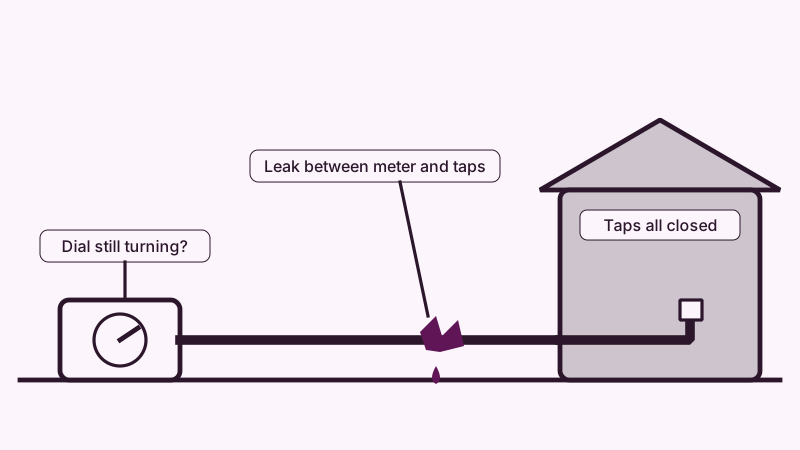
Suspect a burst? Go to the meter. Close every tap, switch off the dishwasher and washer, then watch the dial in the box by the curb. If it creeps forward, water is escaping somewhere between that box and your fixtures. Everything else on this page, from sounds to stains, helps you work out where. A slow drip is a different problem, and the leaks and burst pipes overview handles that side.
What does a burst pipe look, sound and feel like?
Five signals matter: visible water, a noise in the wall, a spinning dial, weak flow at several taps together, and a bill that leaps. Even one of them justifies closing the main valve and looking harder, because a real burst gets worse by the minute.
Think of them as a checklist, from most to least obvious:
- Seen. Spray, a dripping ceiling light fitting, drywall that bulges like a pillow, paint that bubbles.
- Heard. A steady rushing sound inside a wall after the TV is off.
- Metered. The dial turns while the house sits idle.
- Felt. Flooring that is spongy, or a patch of slab warm to bare feet.
- Billed. A usage jump with no new habit to explain it.
Slow seeps behave differently and stain over weeks. A true burst moves gallons in minutes.
Could the break be below the floor?
Hidden breaks show up through sound and temperature. Listen for flowing water in a quiet house, feel for one warm stripe on the floor, and check carpet along exterior walls. Where a crawlspace exists, look for mud or standing water below the access hatch. A silent house with a turning dial points down.
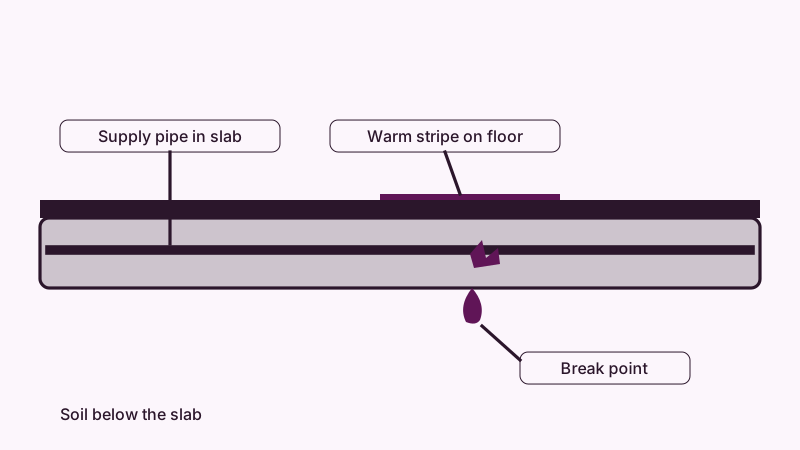
Plenty of postwar tract houses in Torrance, Gardena and Lawndale were built with supply lines in or beneath the concrete. Finding one failure there takes gear: a plumber isolates each line with a pressure test, then uses listening equipment to narrow the spot. Cutting concrete blind is an expensive way to be wrong.
When the evidence points under the floor, look at slab leak repair or repipe ahead of approving any cutting. The right answer depends partly on how many other lines in the house are the same age and metal.
Hot-side leaks leave one more clue. A heater that fires nonstop although nobody changed their routine can mean hot water is draining away beneath the floor.
What do you do right after it lets go?
Close the main valve. Next, open a tap at the bottom of the house so the lines empty, and stay away from wet outlets or the panel. Lift valuables off the floor, take dated photos, then phone a plumber. Cleaning comes last.
Valve location varies by house: look at the meter, the point where the line enters the wall, or beside the water heater. Old gate valves with round handles can seize, so turn yours a little this weekend while nothing is wrong. Ball valves with a lever need only a quarter turn.
If neither valve moves, your water utility can close the street-side meter. Dial the customer line on a recent statement, since the provider changes from city to city.
After the water stops:
- Lift rugs and move cardboard and electronics off wet floors.
- Run a wet vac over puddles only where nearby outlets are dry.
- Leave soaked drywall open to dry, with fans, instead of painting it over.
- Keep photos and receipts. A claim on insurance for a burst pipe tends to hinge on the break being sudden.
If water is still pouring, see how urgent burst pipe visits get arranged, and send the quote form.
What breaks pipes where winters are mild?
Hard freezes are uncommon in the South Bay, so failures here trace to rusted galvanized steel, pinholes in thin copper, pressure set too high, or ground movement. The causes leave different marks, and the page on the causes behind a split pipe sorts them out.
Pressure is cheap to check. California's plumbing code (CPC 608.2) calls for a pressure-reducing regulator when static pressure would exceed 80 psi, which is why many houses carry one where the street runs hotter. A hose-bib gauge costs less than lunch. A reading in the 90s plus knocking pipes is worth a regulator conversation before an aging joint fails first.
Can a weeping threaded joint or PVC crack be sealed temporarily?
Temporary, yes. Permanent, rarely. Epoxy putty, self-fusing tape or a clamp coupling can slow a seep until Monday morning. A cracked fitting or a pipe split along its wall must be removed and swapped for new pipe, so treat any patch as a bridge to a proper repair.
For threaded steel or brass, close the water, dry the pipe thoroughly, then press putty or stretch tape over the weep. Worn threads or pipe movement usually cause these. For PVC, a rubber sleeve with steel clamps can bridge a crack briefly.
Neither trick belongs inside a closed wall. Two related pages go deeper: PVC joints that leak and leaks in plastic supply pipe. Gas pipe is different: do not attempt it, since California law reserves that work for a contractor.
How fast does a burst waste water?
Under full street pressure, a split pipe can pour out several gallons every minute, so an afternoon means hundreds. Small leaks add up too. According to EPA, ordinary household leaks waste upward of 9,300 gallons annually, and a faucet that drips each second loses more than 3,000.
The meter test beats hunting for puddles for exactly this reason. A doubled bill is the first hint, and the article on high water bills shows how to rule out a running toilet or sprinkler fault.
Common questions
Typically how long is the repair?
Exposed pipe can often be cut and replaced in an hour or two. Walls, slabs and cramped crawlspaces stretch that, because surfaces must be opened, the failure located and the line pressure tested afterward. Widespread corrosion can turn the visit into a repipe quote.
What belongs in the quote for this kind of repair?
Look for the scope in writing: does it include opening and patching the wall, or only the pipe itself? Ask who pulls any permit on bigger work, and what changes in the price if another leak appears. A contractor license is a state requirement beyond a modest job size, and the state board offers a lookup.
Who needs to be home?
Briefly, yes. An adult shows the shutoff, points out the damage and approves the quote, which takes a few minutes. If that cannot be you, send a trusted person. Keep the water off, clear a path to the wet area and shift furniture beforehand.
When can the main go back on?
Wait until the damaged section is replaced or capped. Open the valve slowly and watch the repaired spot plus the dial. A dial that still moves with all fixtures off signals a second leak, so close the valve again and call the plumber back.
Can a break stay invisible for days?
Yes. Within a wall cavity or under flooring, water can run for days before any mark shows on the surface. That lag is why a moving dial is more reliable than looking for puddles, and why an odd bill deserves a look even in a dry-looking house.
This guide is one of many on plumber torrance.
Sources used
- EPA WaterSense, Fix a Leak Week
- Published guides from Southern California plumbing businesses, checked November 2026
Last updated