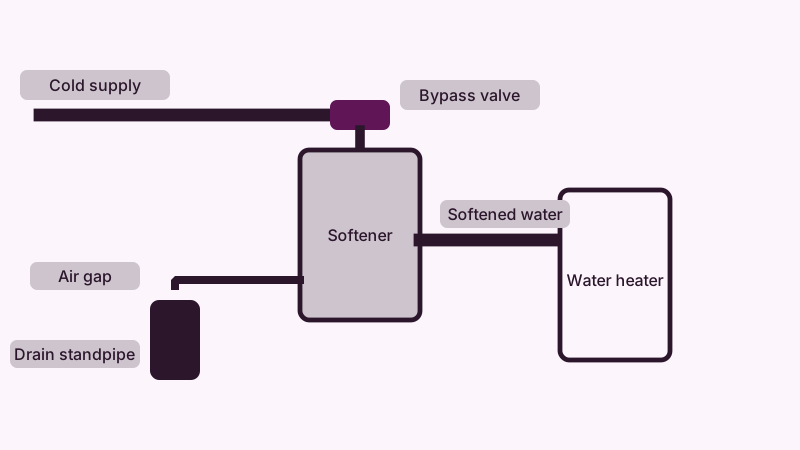
If you can sweat a copper fitting or push a PEX connection and you have a spare wall near the water entry, you can install a softener. The job is a bypass valve, an inlet and outlet connection, a drain run that ends in an air break, and a power outlet. What trips people up is the layout and the rules, not the tools. Prefer to pay someone? Softener installation by a plumber covers that route.
Can you really install a water softener yourself?
Yes, if your supply pipe is accessible and you are comfortable cutting and joining pipe. A basic installation takes a few hours: shut the water, cut in a bypass, connect inlet and outlet, run a drain, add the salt and set the hardness. The cases for a plumber are cramped plumbing, a permit requirement, or a house with mixed old pipe.
Before buying anything, draw the layout. A tank softener wants roughly two feet of square floor space, a grounded outlet it can reach, somewhere to send wastewater, and a tie-in on the supply ahead of the water heater branch. Ordinary shoppers underestimate that last point. Soft water is wanted for the heater, but not for the outdoor spigots or the toilets in some households, so decide that before cutting pipe.
Which tools and parts go in the cart?
The list: the softener itself, a bypass valve (often in the box), two flexible connectors or pipe matching your supply, a pipe cutter or PEX tool, fittings, sealing tape, tubing for the drain with a clamp, test strips for hardness, and a bag of salt. The manual states the working pressure the unit tolerates, commonly somewhere in the 20 to 120 psi range.
Identify your pipe first. Tract houses across Torrance, Gardena and Lawndale built after the war frequently carry galvanized or copper supply, and new brass joined straight to old galvanized can corrode or weep at the join. A dielectric union at the transition helps. If the pipe near your main is brittle or scaled, replacing a section is smarter than forcing a connection. See what repiping costs if that looks likely.
Test your water so you can set the unit. A strip measures hardness in grains per gallon. The USGS rates water over about 180 mg/L (roughly 10.5 grains per gallon) as very hard.
In what order does the plumbing work go?
Shut the main and empty the line. Cut into the pipe where the softener will tie in, then mount the bypass with its inlet and outlet pointing the correct way. Join the lines, send the drain to a standpipe or floor drain through a gap, plug in the controller, add salt and flush before anyone drinks from it.
- Close the main, then open one low tap and one high tap so the pipes empty.
- Cut out a section of pipe on the supply before the water heater branch.
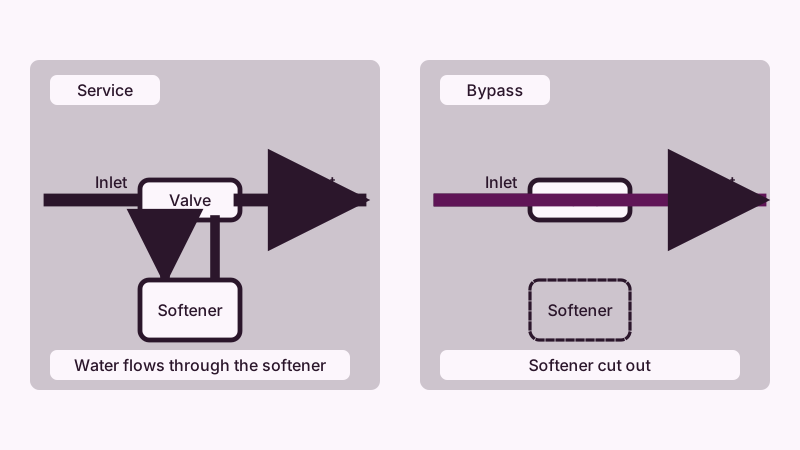
- Install the bypass valve in the position the manual shows. The arrows on the head say which way is inlet and outlet. Reversing them is the most common mistake.
- Attach connectors, using thread tape on threaded ends.
- Route the drain tube with a visible gap, so dirty water can never be pulled backward. A laundry standpipe is the usual landing spot.
- Leave the unit on bypass, bring the water back, and watch each joint for seepage.
- Move the bypass to service, run a manual regeneration, set the hardness and the clock.
Keep the bypass in reach. It lets you cut the softener out when you need to service it.
Does Torrance allow salt-based softeners?
California has no statewide ban, but state law lets some local agencies limit self-regenerating softeners that discharge salty brine into the sewer, after required findings. Some Southern California utilities have done so. No Torrance ban turned up in what we read, so phone the city building division and your water supplier or sewer agency ahead of any purchase.
The statute behind this is the Health and Safety Code article that begins at section 116775 and Water Code section 13148. If your city or sewer agency does restrict them, ask about salt-free conditioners or exchange tanks, which are generally allowed where self-regenerating units are not. A permit question can come up as well, since some building departments treat new plumbing connections differently. A short call to Building and Safety settles it. The page on salt-based units takes the salt question further.
Will a softener get rid of scale already in your pipes and fixtures?
It stops new scale from forming, yet old crust does not vanish fast. Soft water may loosen some deposits across weeks, but crust already on showerheads, aerators and heater elements normally needs a vinegar soak or a descaler. Scale deep in aging galvanized pipe is often beyond reversing.
For a fixture, submerge the part in plain white vinegar for roughly sixty minutes, scrub lightly with a brush, then rinse. For a tankless heater, flushing with vinegar through its service valves is the maker's usual method; check your manual. Fixture-by-fixture methods sit in the pages on taking hard water scale off and keeping it from coming back.
What is the water like across the South Bay?
Hardness changes with the supplier and the street. Torrance Municipal Water, Cal Water and Golden State Water each serve some part of the region and each blends imported and local supply in its own proportions. Published estimates for Torrance disagree widely, so test your own tap and ignore any single figure found online.
Every utility issues a yearly quality report, and the hardness line in it is your starting number. A softener sized from a guessed number tends to be either wasteful or too small.
When does paying a pro make sense?
Bring one in when the supply pipe is hard to reach, a new drain must be run, old galvanized pipe is corroded, or a permit or inspection applies. Help is also worth it when a recirculation loop, regulator or tankless heater complicates where the unit can go.
Price matters as well. The breakdown in whole-house softener installation cost shows the range, and the quote form is the way to book a visit. Running costs count too, so see how a softener can push up a water bill before choosing a thirsty model.
Common questions
What share of a day should I plan for?
A confident beginner usually needs a half day, including cutting pipe, setting the drain and running a first regeneration. A plumber working in an accessible garage or utility room can often finish faster. Tight spaces, old galvanized pipe or a new drain line add time, and the first regeneration cycle itself runs a few hours.
What do I confirm ahead of purchase?
Test hardness, find the spot where supply enters the building, confirm that a drain and a socket are close by, and ask the city or sewer agency about restrictions on salt-based units. Match capacity to household size and hardness, and compare salt use per regeneration, since that drives running cost and any sewer limits.
Must someone be home when a pro does it?
Someone over 18 lets the plumber in and points out the water entry, the garage or laundry area and the socket. The supply goes off during the work, so schedule laundry and showers elsewhere. Shift boxes away from the tank's intended spot.
Where does the softener sit relative to the heater?
On the cold supply before the line splits to the heater, so both hot and cold are softened. Many people tee off a separate unsoftened line for outdoor spigots and irrigation so they are not spending salt on lawn water.
Does installing a softener void anything on my house plumbing?
It should not, but check the water heater maker's documentation and your softener warranty. Some brands set conditions on installation, such as a bypass and a pressure limit. If a permit applies, follow it, because unpermitted plumbing can complicate insurance and a later sale.
The rest of our guides start from plumber in Torrance.
Sources used
- State statute on local limits for water softeners, Health and Safety Code article starting at 116775, via Justia
- California Water Code section 13148 (salinity control from self-regenerating softeners)
- USGS, water hardness classes, checked November 2026
Last updated