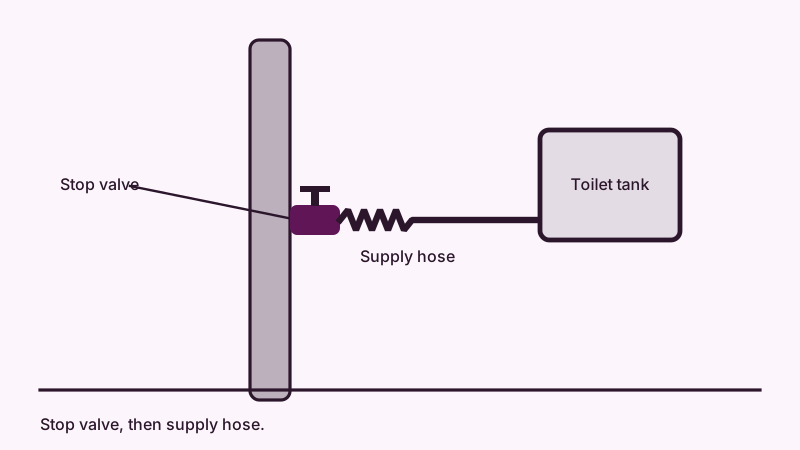
Before you fix a toilet, you shut it off. If the little valve behind it will not turn, will not stop the water or drips from its stem, the fix starts there. The valve is called an angle stop, and it is usually a quarter-turn ball type on newer work and a multi-turn compression type on older houses. A weep at the handle can sometimes be snugged up. One that is seized, green with corrosion or sweating at the pipe costs less to replace than to coax along. See toilet repair in Torrance for the full job list, and use the checks below to decide what yours needs.
How do I know the toilet shut off valve is the problem?
Three signs: the valve will not turn, turning it fully does not stop the water, or water beads at the handle stem or the pipe joints. Test it by closing the valve, flushing the toilet once and watching the tank. If the tank refills, the valve is not sealing. If you cannot close it at all, treat it as failed.
Do not wrench a stiff valve. An old multi-turn stop can crack or snap its stem, and then water is running with nothing to stop it. Locate the main shutoff first, normally in the meter box or at the spot the pipe enters the house, so the whole supply can be cut if something gives way. The city side of the meter belongs to the water supplier, so touch only the valve on the house side.
Can I cure a dripping stop valve myself?
Seepage around the stem is often curable: shut the valve fully, then apply a wrench to the packing nut for a quarter turn. Still dripping, and the packing has worn out, so replacement is next. Water where the line meets the tank points at the supply line nut or its washer, a simple correction.
Work in this order:
- Lay a towel and a shallow tray beneath the valve.
- Turn the packing nut a quarter turn, and stop there.
- If the drip is at the supply line, tighten that nut by hand first, then a touch with a wrench. A stiff, old or kinked line should simply be replaced.
- Reopen the valve gradually and wait a minute. Wipe the joints dry and run a tissue around them to catch a slow weep.
A valve that will not hold back water is past a wrench. It needs replacing.
When should the shut off valve be replaced?
Swap it out when it will not shut completely, will not turn, wears green or white crust, leaks from the body after you adjusted the packing, or has sat unmoved for twenty years or more. Doing it during a toilet swap is cheap insurance, since the plumber is already on site.
Valves in older Torrance homes can be original to a postwar house, sitting on galvanized or old copper stubs. Galvanized stubs rust from the inside and can crumble when loosened, a strong argument for leaving removal to a plumber. A plumber will often replace a multi-turn valve with a quarter-turn type and a braided stainless supply line, so the next shutoff is easy.
What does a new stop valve cost?
Guides for 2026 show about $150 to $350 for a valve fitted, although the part alone costs just a few dollars up to about $20. What it connects to sets the price: clean copper taking a compression valve is simplest, and a soldered fitting or corroded galvanized stub costs more.
If the whole house must be isolated at the main, time goes into the price. Damage to the wall pipe adds a repair on top. The price rises when the valve is a separate visit and falls when it is done alongside another job. For the whole picture, plumber replace toilet cost shows the valve as one line in a toilet swap, and service call cost explains the minimum charge.
Is a compression valve better than a push-fit one?
Each has a place. Compression valves grip clean copper and are the common choice. Push-fit valves go on clean copper or PEX without tools, provided the pipe end is round and unscratched. Soldered valves are the permanent option and cost more to fit.
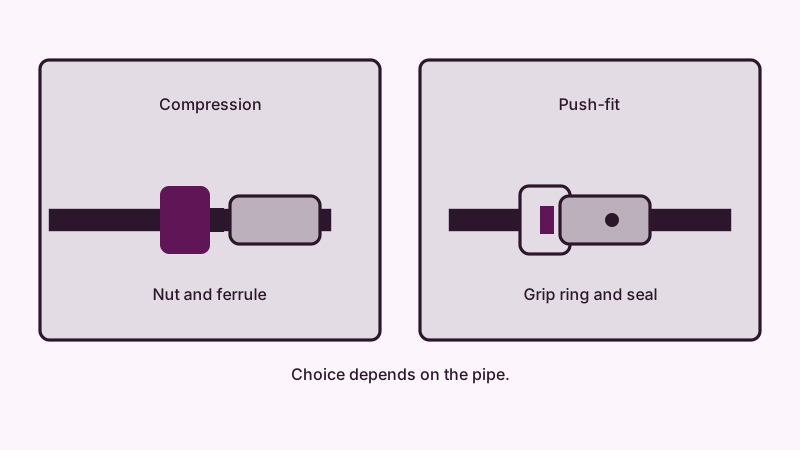
A plumber chooses by what comes out of your wall. Copper stubs in good condition take compression valves. PEX stubs take a valve made for PEX. Galvanized stubs often have to be cut back and transitioned to copper or PEX, since a new valve on corroded steel will leak in time.
What if the valve works but the toilet still runs or leaks?
In that case the valve is innocent. A tank that refills forever usually has a tired flapper or a sticky inlet valve, and a wet floor may be a failed wax seal. The EPA's average for household leaks is over 9,300 gallons yearly, and toilets feature on the list of usual suspects.
Next stops: the running toilet guide, the fill valve repair page, or the toilet leak plumber page. For a weak flush, see toilet flush repair.
Common questions
Should I ever move the valve if it works?
Yes, a little. A valve nobody ever turns seizes with mineral scale, especially in hard water. Closing and opening each stop valve in the house once or twice a year keeps the stem free. Turn gently, and if one resists, leave it alone and have it replaced before it is needed in an emergency.
Which direction closes it?
Clockwise to close, the same as most taps. On a quarter-turn valve, the handle runs perpendicular to the pipe when it is closed and parallel when it is open. If the handle is an oval or has lost its screw, a pair of pliers on the stem will do it, gently.
How long does the valve job take?
With the house supply off, a plumber commonly needs under an hour per valve. A damaged pipe or an opened wall stretches that, and your own bathroom's timing is set out in the written quote after a visit, alongside the price.
Does a valve swap need a permit?
Swapping one fixture stop for another is generally upkeep rather than a permitted project, though cities differ. If the job reroutes pipe or opens a wall, check with your city's building office. The plumber will know when a permit applies.
What should be in the quote?
Look for the valve type and supply line, and whether both are priced in. Ask how a corroded pipe behind the old valve would be dealt with, and whether the new valve is tested under pressure before the plumber leaves.
This guide is one of many on plumber torrance.
Sources used
- Published 2026 plumber price guides for shutoff valve replacement ($150 to $350 installed), read November 2026 (plain label)
- U.S. EPA WaterSense, Fix a Leak Week
Last updated