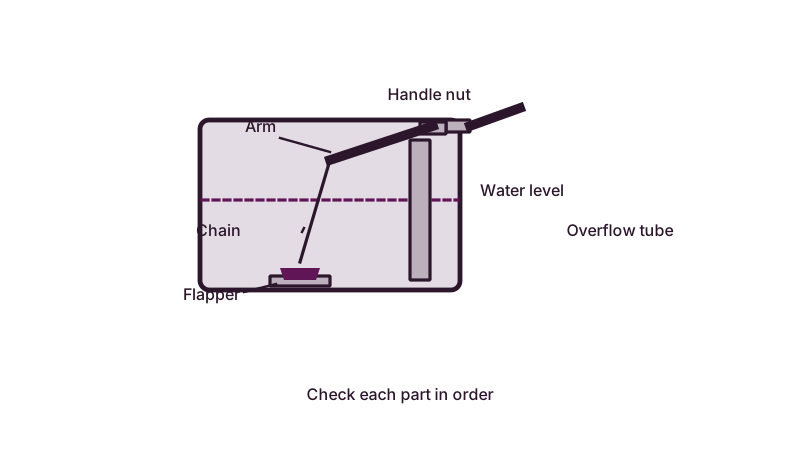
Lift the tank lid, press the handle, and watch the inside. That single look answers most of the question. If the handle moves but the arm inside barely twitches, the mounting nut has backed off. If the arm swings but the flapper stays down, the chain is slack or unhooked. Neither calls for a new toilet. The toilet repair page covers the version of this job that a plumber handles.
Why is the handle loose and the toilet not flushing?
The handle is bolted through the tank wall to an arm inside, and a chain links that arm to the flapper. A loose handle usually means the mounting nut has worked free. If the toilet will not flush, the break is somewhere along that chain of parts: nut, arm, chain or flapper. Lift the lid and watch each one move.
Work in this order, because each step takes a minute:
- Handle nut. Wiggle the handle. If it spins freely, tighten the nut inside the tank.
- Arm. Check that the arm is attached to the handle shaft and not bent or snapped.
- Chain. Look at the chain between arm and flapper. It should hang with roughly a finger-width of play, no more.
- Flapper. Make sure the rubber flapper lifts and drops back cleanly onto the seat.
- Water level. Check that the tank refills to the line marked on the overflow tube; a half-empty tank flushes weakly.
How is a wobbly handle tightened?
Reach inside the tank and turn the mounting nut on the handle shaft by hand or with pliers. Most handle nuts use a left-hand thread, so tightening means turning counterclockwise, which feels backward. Snug is enough. Cranking it down can crack the porcelain around the hole.
If the nut spins without gripping, the plastic threads on the handle may be stripped. In that case a replacement handle is the fix, and it costs little. Match the handle to your tank: front-mount, side-mount and corner-mount handles are not interchangeable, and brass and plastic assemblies differ in length. Bring the old handle along, or a photo of it, when you shop.
Do not forget the flush lever's position. A handle that sits crooked after tightening can rub on the tank wall and stick.
What if the handle works but nothing flushes?
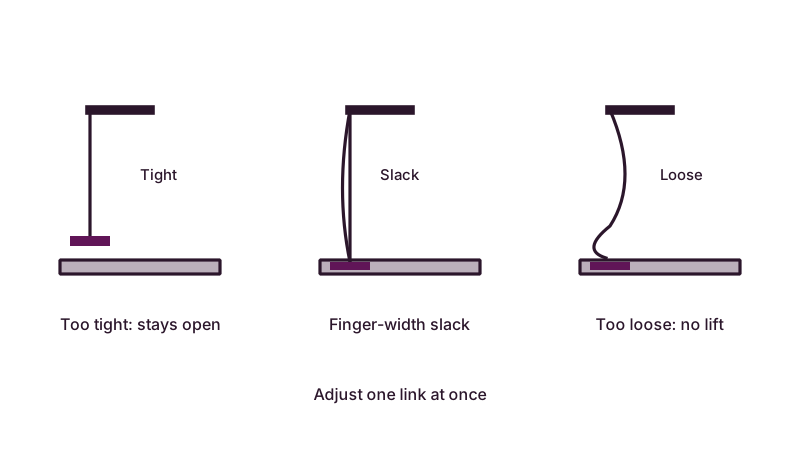
Then the chain has come off the arm or snapped, or the arm is detached from the handle. Re-hook the chain to the arm, or swap a damaged one, leaving a finger-width of slack. A taut chain props the flapper open and the toilet runs; a sagging one never raises it.
The hook and clip at the end of a chain can pop off after years of use, and the fix costs pennies. Check the flapper itself at the same time: if it is warped, brittle or covered in slime, replace it, because a worn flapper also leaks. See toilet flapper repair, and if you are unsure which part to buy, flapper valve types shows the common shapes.
When is the problem not the handle at all?
When the handle and chain work, the flapper lifts, and the bowl still will not flush well. Then look at the water level, the fill valve and the bowl's rim jets, or suspect a clog downstream. A bowl that fills and drains slowly, or rises toward the rim, is a drain problem.
Several checks separate these cases:
- Tank low on water. Adjust the fill valve or float, or replace the valve.
- Flush starts strong then fades. Mineral scale in the rim holes. Hard water causes this in parts of the South Bay, and a vinegar soak of the rim can help.
- Bowl rises and will not drain. A clog in the trap or drain. Our guides on clearing a blocked toilet and toilet flush repair take this up.
- Water keeps running after flush. Flapper or fill valve, covered in toilet running.
Replacing a worn flush valve is bigger work, and swapping the valve with the tank still on covers which parts allow it.
What will a fix set you back?
The parts barely register. A handle or chain is typically a few dollars off a hardware shelf, which makes the do-it-yourself route sensible. With a plumber, the charge is largely the call itself, and a flat-rate toilet repair can include handle and flapper together. The number that matters is the quote you are handed after the plumber has looked.
Other small toilet jobs are priced in replacing a fill valve. When the toilet is beyond saving, the cost of a replacement toilet is the next stop.
Common questions
Can a toilet flush with a broken handle?
Yes, in a pinch. Lift the tank lid and raise the flapper by hand using the chain or the flapper itself, and the toilet will flush. That gets you through a day, but it is a temporary measure. Replace the handle soon, because a broken one tends to leave sharp edges and a gap that can drip.
How tight should the chain be?
Aim for a finger-width of slack with the handle at rest. If it is tight, the flapper cannot seat and water runs into the bowl. If it is loose enough to drape over the flapper, the handle will travel without lifting it. Adjust one chain link at a time.
Which parts of the handle assembly are worth replacing together?
The handle, arm and mounting nut come as a set, and swapping the full set costs little. Replace the chain and flapper at the same time if they look worn. Doing the lot at once is quicker than returning to the tank every few weeks.
Must I be there while it is done?
Someone of adult age should open the door and point to the right toilet, because many houses have more than one. The job is short. If you are out, ask a trusted adult to be there and settle the price.
Why does the handle keep loosening?
Vibration and use can back off the nut, and stripped plastic threads or a cracked mounting hole will not hold. Tighten the nut the correct direction, replace the handle if the threads are gone, and check that the tank lid sits properly and is not pressing the lever arm.
This guide is one of many on the plumber guide for Torrance.
Sources used
- Plumbing trade guidance on toilet flush handles, chains and flappers, checked November 2026
Last updated