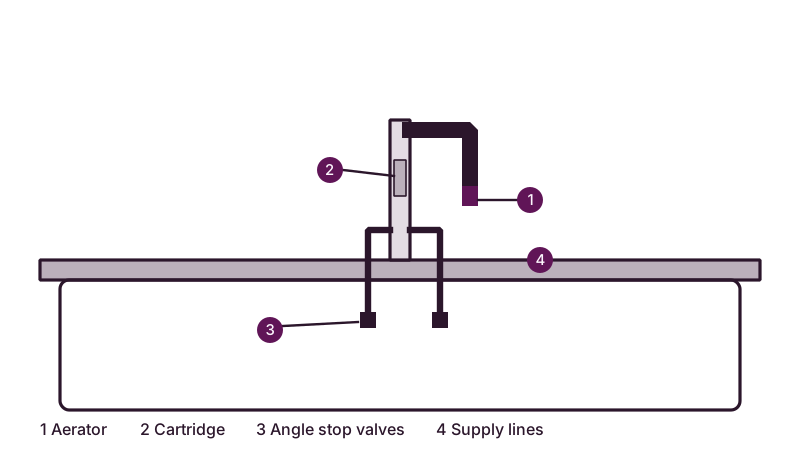
First learn whether the weak flow is confined to the kitchen. Run the bathroom taps and the shower. If they are strong, the trouble is local, meaning a plugged aerator, a shutoff valve not fully open, a bent supply line or a tired cartridge. Weak everywhere points upstream, and whole-house low pressure applies instead. The kitchen sink often shares its space with the disposal, which has its own page on garbage disposal repair.
What would weaken only the kitchen faucet?
Mineral scale in the aerator is the most common cause. The aerator is a little mesh cap at the spout's tip, and grit and calcium deposits plug its fine holes. A faucet with a clogged aerator sprays sideways or trickles. Unscrew it, rinse it, and see whether the flow recovers.
Next come the two small shutoff valves below the sink, known as angle stops. If one is not fully open, flow drops. Check the supply lines for sharp kinks, especially after anything was stored under the sink. Inside the faucet body, a worn cartridge or a plugged inlet can cut flow too.
One side weak, the other fine? Check the line on the weak side first. That one clue halves the list. A water filter or reverse osmosis unit under the sink can also restrict flow when its cartridge is old.
What is the way to clean a blocked aerator?
Turn the aerator counterclockwise by hand, or wrap a cloth around it and use pliers gently so you do not scratch the finish. Take it apart and note the order of the washer, screen and housing. Pick out debris with a pin or a small brush.
Let the parts sit in white vinegar for several hours to dissolve scale, then rinse, reassemble and thread the aerator back on. Run the water without the aerator for a few seconds first, to flush any loose grit out of the spout. If the faucet's flow is still weak, the problem is further back.
Hard water makes this a repeat task. Cal Water's 2025 report for the Hermosa-Redondo system shows groundwater hardness near 502 ppm, which it classes as very hard. Torrance Municipal Water's 2025 report shows total dissolved solids around 696 ppm in its groundwater and 541 ppm in imported water. Further reading: clearing hard water scale and stopping it before it forms.
What should I check under the sink?
Swing open the cabinet doors and light up the supply lines and the two valves, and look for kinks, leaks and corrosion. Turn each angle stop all the way open, which means counterclockwise for most. If a valve is stiff or crusty, do not force it, because an old stop can break and leave you with a flood.
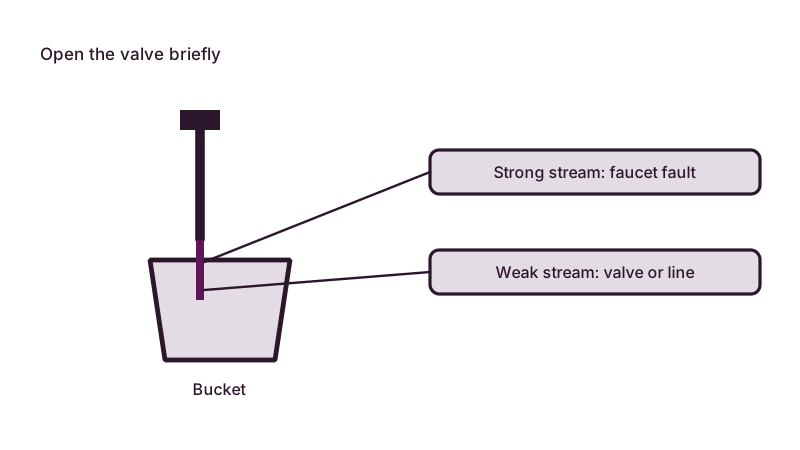
Remove the flexible supply line from the faucet side, point it into a bucket and open its valve briefly. A strong stream shows the line and valve are fine, which puts the fault in the faucet. A weak flow means the valve or a line upstream is restricted. Flexible braided lines are inexpensive and are often replaced when they are old.
The stop valves and lines are the usual place a pressure check ends, and replacing them is a short plumber job. The faucet end of the price is in faucet installation costs.
What if the kitchen faucet itself is worn out?
A faucet that is a decade or more old can have a worn cartridge, a clogged inlet screen or mineral buildup inside the body. A cartridge swap often restores flow on a single-handle faucet. If the faucet is corroded, leaking at the base or hard to turn, a replacement is usually the better spend.
Pull-down sprayers add another failure point. The diverter in the faucet body sends water to the spray head, and the hose can kink or clog. If the flow is weak only when the spray is on, check the hose and the spray head screen.
A new faucet also fixes flow restrictors: many modern faucets cap their flow to save water, so a new one may seem to be weaker than an old one with the aerator removed. Compare the flow rating on the box with what you have now.
When does low pressure at the sink point to something bigger?
Weakness at other fixtures, or a sudden onset while the water bill climbed, raises other candidates: the pressure regulator, a main shutoff that is partly shut, corroded galvanized pipe, or a concealed leak. The state plumbing code's regulator rule kicks in above 80 psi of static pressure, and a failing one can push pressure in either direction.
Tract homes in older parts of Torrance and Gardena may be plumbed with galvanized or early copper supply lines, and their interior corrodes and narrows over decades, cutting flow at every tap. Those are worked through in reasons for low pressure, house-wide pressure fixes and weak hot water pressure.
If the cause stays hidden, or the fix involves the main or pipes in the wall, use the quote form to explain the trouble, and someone local is arranged. The Del Amo Plumbing home page shows what else we arrange.
Common questions
What explains a weak kitchen with a strong house?
The trouble almost certainly sits in the kitchen faucet, its supply lines or its shutoff valves. A clogged aerator is the most common cause, followed by a half-closed angle stop, a kinked line, a worn cartridge or an old filter under the sink. Start with the aerator, since it takes five minutes and costs nothing.
What makes only the hot side weak?
When cold is strong and hot is feeble, look along the hot line: a partly closed valve, scale at the faucet's hot inlet, or heater sediment clogging the hot pipe. Check the hot angle stop first. If other fixtures also have weak hot water, the water heater's outlet or the line from it may be restricted.
Can I fix low pressure at the sink myself?
Yes for the aerator, the angle stops and a basic cartridge swap, using the shutoff and ordinary hand tools. Leave the main, the regulator and any work inside walls to a plumber. Never force a stuck shutoff valve, because it can break and flood the cabinet.
How long will this repair run?
A clogged aerator or valve is a short stop. Supply lines or a cartridge take around an hour, and replacing the faucet itself can take up to two hours. If the problem is in the main line, the regulator or the walls, the plumber will tell you after a look, and the quote comes first.
Sources used
Last updated