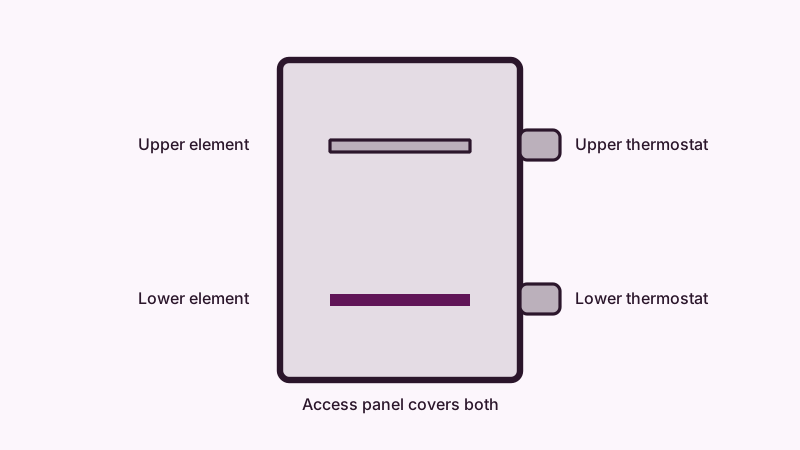
Only electric tank heaters have heating elements. If yours runs on gas, there is no element to replace, and the usual suspects are the thermocouple, the pilot and the gas valve, which the water heater repair hub walks through. An electric tank works differently: two metal rods are immersed in the water, an upper and a lower, and each heats until its own thermostat is happy. Either can burn out, and the symptoms point to which.
How do I know the heating element has failed?
Three symptoms point here: water that stays lukewarm, a hot supply that disappears after a shower or two, and a breaker that will not stay on. Most tanks carry two elements, so a dead upper one leaves you with no hot water while a dead lower one leaves a small amount that is soon spent. A multimeter confirms which.
Reading the symptoms on a two-element tank:
- Cold all the way. Look at the upper element, its thermostat, or a high-limit button that has popped.
- A shower or two, then nothing. Probably the lower element; the upper one warms only the top slice of the tank.
- Breaker pops the moment it is reset. A shorted element is grounding out. Leave the breaker off.
- Hot at first, tepid for hours after. A tired thermostat, or scale insulating the lower element.
Eliminate cheap explanations first: the breaker, the reset button on the upper thermostat, and whatever else shares that circuit. A broader checklist is in our piece on losing hot water, and the thermostat replacement page deals with the neighboring part that fails just as often.
Can I test the element myself?
Yes, provided you are at ease around electricity. Kill the breaker, prove with a tester that nothing is live, take off the access panel and insulation, then measure the element's resistance. An open circuit means a broken element, and a reading between a terminal and the tank means a short. If any step feels shaky, stop and phone someone.
The safety order matters more than the tools:
- At the main panel, switch off the water heater's breaker.
- Lift off the cover and insulation, and use a non-contact tester to be sure no power reaches the terminals.
- Disconnect one wire from the element and set the meter to resistance.
- A working element reads a low, steady number of ohms. A broken one reads open. A reading to the tank wall means a short.
Do not restore power while the cover is off. Do not energize the heater until the tank is completely full, because an element sitting in air burns out within minutes. If the wiring sits near pooled water, or the panel is damp, stop there and call a plumber.
What does a new heating element cost?
The part runs about $15 to $60 in published guides, and having a plumber fit it lands around $150 to $350, with Angi's figure near $200 to $300. A thermostat swap is $100 to $300, and an element-plus-thermostat visit commonly totals $200 to $400. Some firms add a diagnostic fee of $50 to $150.
Doing it yourself costs the part, plus an element wrench if you do not own one. Every figure here is lifted from published price guides, so use it only as a rough yardstick. The price that counts arrives in writing after a visit. The pieces add up like this:
| Item | Guide range |
|---|---|
| Element, part only | $15 to $60 |
| Low-watt-density or stainless upgrade | $10 to $25 more |
| Plumber replacing one element | $150 to $350 |
| Thermostat replacement | $100 to $300 |
| Element and thermostat together | $200 to $400 |
| Replacing a whole electric heater | see what an electric heater replacement costs |
What should I match when buying a new element?
Copy the old element's voltage, wattage and mounting style. The numbers are stamped on the element and printed on the heater's rating label. Residential elements are commonly 240 volts, either screw-in or a four-bolt flange, and a low-watt-density type is gentler on mineral scale. Take the old element along when you shop, or snap a photo of the label.
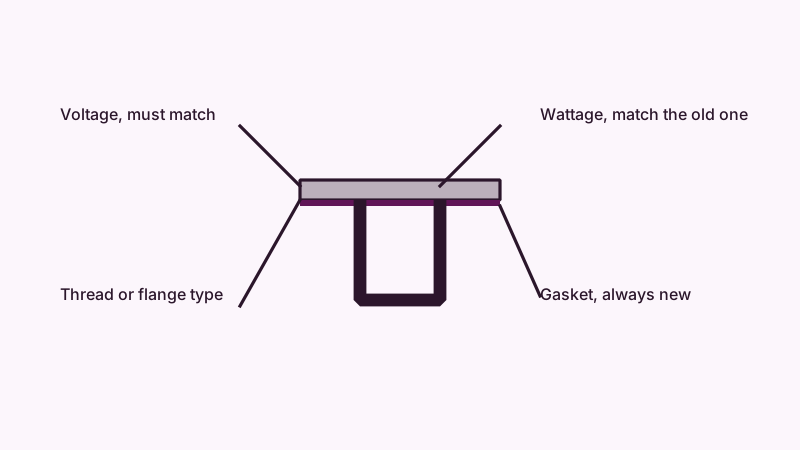
Details worth checking:
- Voltage. Do not substitute a different voltage. A mismatch wastes heat or damages the unit.
- Wattage. Match the old element, unless the heater's label allows another size.
- Thread or flange. Screw-in and bolt-on elements are not interchangeable without changing the opening.
- Gasket. A new one is part of the kit, and reusing the old one is a common cause of leaks.
A corroded opening or tank wall means a new element will not fix the real problem, because the heater may be near the end of its working life. The anode rod deserves a look too; see anode rod replacement.
Does hard water kill heating elements?
Scale coats an element and insulates it, so it runs hotter and gives out sooner. Torrance supplies a blend of imported water and local groundwater, and the city's 2025 report lists no hardness figure, which is why outside numbers disagree. A cheap test strip or drop-count kit gives your own reading before you commit to a softener or a scale-resistant element.
Draining and flushing the tank on a schedule that the manufacturer recommends clears loose sediment. If you find scale thick on the old element, read hard water scale prevention and consider an upgrade to a low-watt-density type.
When is it smarter to call a plumber?
Hand the job over if the element is seized, if the opening weeps once the element is out, if the breaker still trips after a swap, or if the tank is old and rusty. The job also needs the tank drained, which gets messy when the drain valve is clogged with sediment.
Some work does not belong in a DIY plan. Replacing the entire heater generally means a city permit plus earthquake strapping, and gas or venting work carries separate rules. Set the repair cost against the tank's age before you spend. If the tank is leaking, emergency water heater repair lays out repair versus replacement.
Common questions
What is the time frame for the swap?
A plumber often needs around an hour once the tank is drained, more if the old element is seized or the drain valve is blocked. Draining, refilling and waiting for the tank to heat adds time before hot water returns.
Does the tank have to be emptied for this?
Yes, at least below the element, since the element sits inside the tank. Power off first, then close the cold inlet, crack open a hot faucet upstairs and drain from the lower valve. After the swap, fill the tank completely before power goes back on.
Can a tankless water heater have an element too?
Electric tankless units do heat water with elements, but they are built as a sealed assembly and are usually serviced by the maker or a plumber familiar with the model. Gas tankless units have no elements at all. Check the manual or ask a plumber, and do not open a unit under warranty yourself.
What if the new element trips the breaker?
Stop and leave power off. A tripping breaker after a swap points to a loose or crossed wire, a short in a second element, a wrong part or water in the electrical compartment. Recheck the wiring with the power off, or call a plumber.
Who can legally do the swap?
Owners can generally replace parts in their own heater. If you hire out, the legal need for a California contractor license begins around a thousand dollars of work, and CSLB's lookup tests a number in seconds. Insist on a written price, and describe the heater on our quote page.
For the wider picture, start with plumber in Torrance.
Sources used
- Published water heater element replacement price guides, checked November 2026
- EPA WaterSense, Fix a Leak Week
- City of Torrance, Annual Water Quality Report 2025
- CSLB, home improvement contracts
Last updated